Men's Office-to-Run Activewear: Translating Tailored Visual Codes Into Technical Performance Garments
- Share
- publisher
- HUCAI activewear
- Issue Time
- Sep 25,2026
Summary
A B2B development guide for men's activewear brands building an office-to-run capsule: how to translate tailored visual codes such as contrast topstitch, clean necklines, waistband construction and straight leg lines into stretch performance garments, and how to hold that silhouette from sample through bulk production.
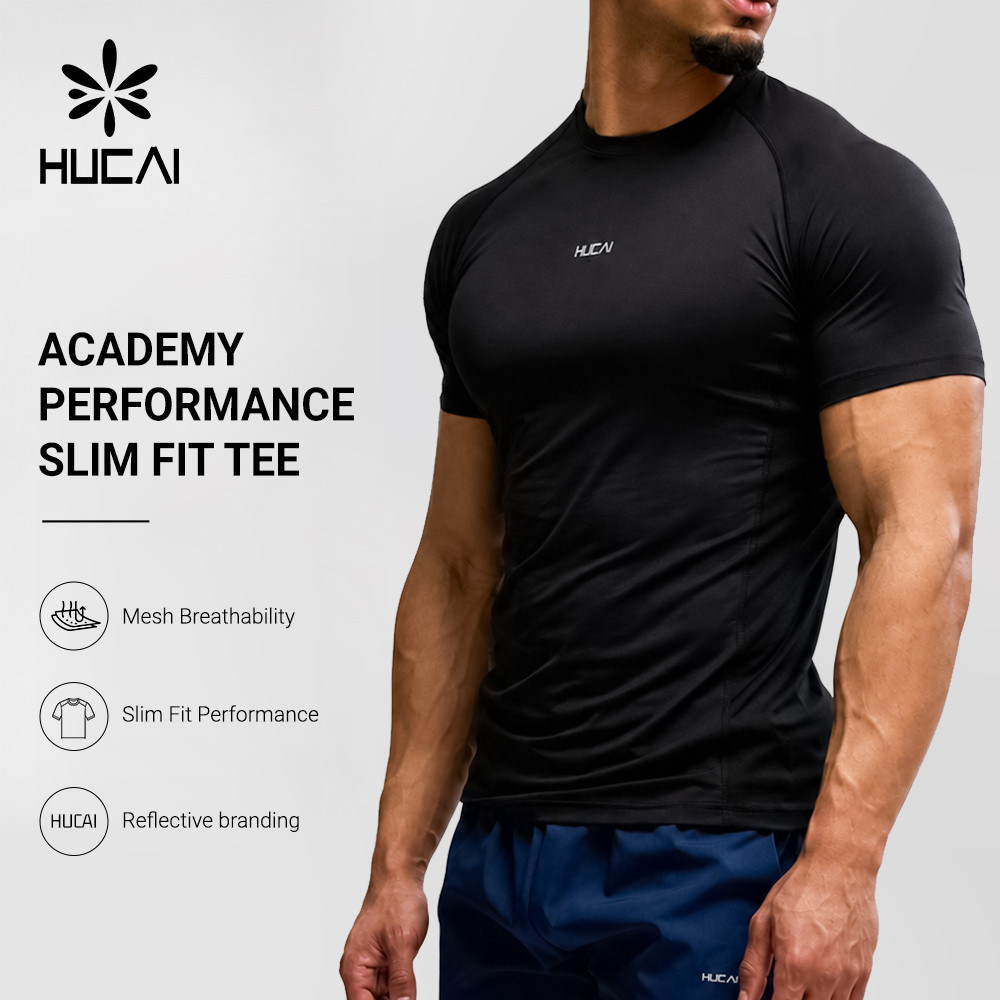
A growing number of men's gym wear brands are chasing the same brief: a collection clean enough for the commute and technical enough for the run home. For buyers sourcing private label activewear, that brief is a development problem rather than a styling problem. Tailored visual codes, from the straight leg line to the contrast topstitch, are borrowed from tailoring, but they have to survive stretch fabric, sweat, and repeated washing. HUCAI activewear supports OEM and ODM development for custom men's activewear, translating tailoring-led references into pattern, fabric and construction decisions that still hold up in bulk.
Reference images rarely survive contact with a production floor unchanged. A pinstripe that reads sharp on a woven trouser behaves differently once it is knitted into a four-way stretch jersey. A tapered leg that flatters in a studio photo can bind across the knee during a training session. The gap between a tailored-looking range and one that merely photographs well is closed by decisions made long before the first sample is cut.
Quick Answer
Translating tailored visual codes into performance activewear depends on four confirmation points: the visual detail itself (stripe, topstitch, clean neckline), the fabric that has to carry that detail, the construction that keeps the silhouette stable in motion, and the measurement tolerance that repeats the look across bulk. Tailored references fail most often when brands confirm the visual direction first and the fabric behavior last. Reversing that order is what keeps a tailored-looking men's collection commercially viable.
Table of Contents
Who This Article Is For
- Growing brands building a hybrid line that has to read smart in the office and function in training
- Private label buyers expanding from performance basics into tailoring-led silhouettes
- Established brands with a confirmed tech pack that need pattern, fabric and grading alignment
- Startups testing whether a tailoring-inspired capsule belongs in their first range
Why This Guide Matters
HUCAI activewear develops men's activewear across OEM and ODM routes, from fabric library selection and pattern engineering to sample approval and bulk production follow-up. The team reviews leg line grading, waistband pressure, seam tolerance and stitch density before bulk cutting, so brands can enter a tailoring-led category with clear expectations about what will and will not hold up at volume.
Why Tailored Visual Codes Fail in Performance Ranges
Observations across leading performance brands such as Gymshark, Castore and Ten Thousand show a consistent direction in men's training lines: cleaner shoulder lines, restrained branding, and silhouettes that borrow proportion from tailoring rather than from classic gym wear. The visual language has moved quickly. The manufacturing discipline required to reproduce it has not always moved at the same speed.
The failure pattern is predictable. A brand selects a reference with a sharp contrast stitch or a narrow side stripe, then discovers during sample review that the same detail behaves very differently on an elastic knit. Discussions across runner forums and training communities frequently describe the result: seams that pucker after the first wash, or panels that read as decorative rather than structural once the garment is on a moving body.
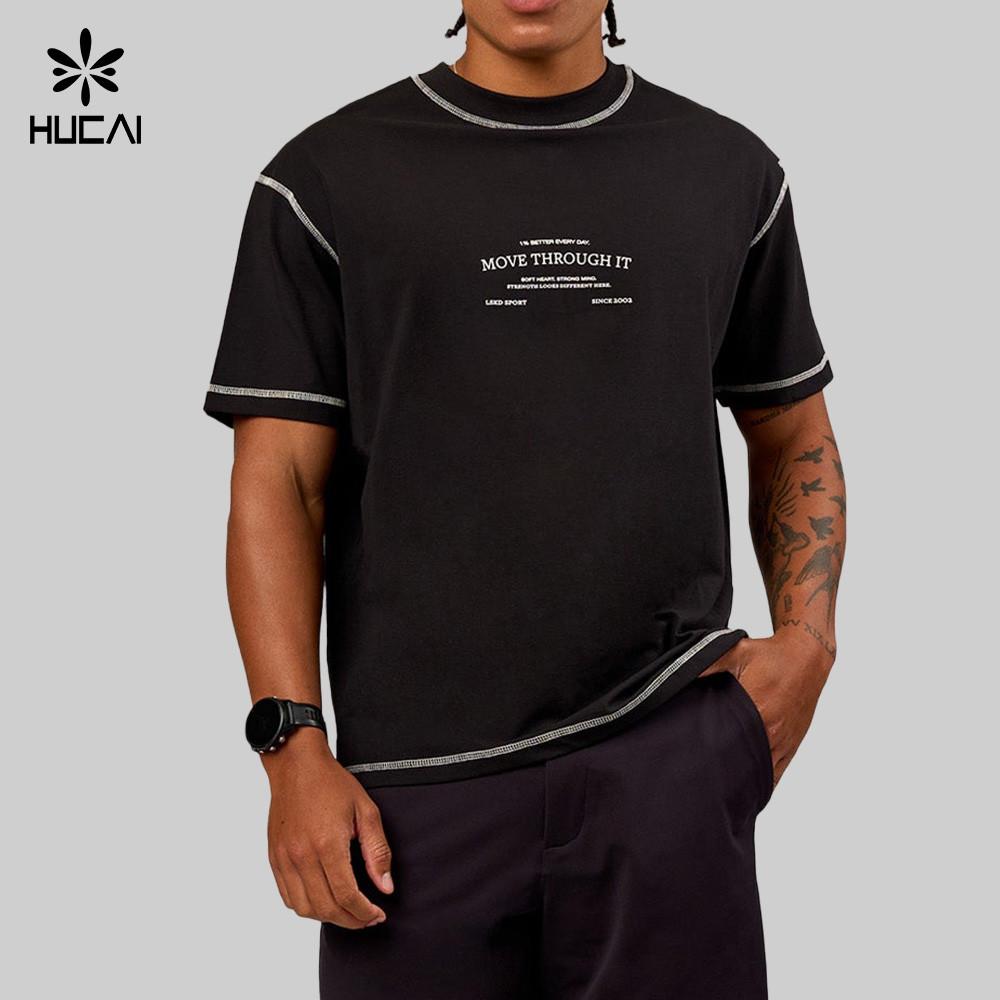
The reason is structural. In tailoring, contrast stitching sits on a stable woven cloth where the stitch line can be placed with confidence and the fabric will not move underneath it. On a four-way stretch knit, the same stitch line has to travel with the fabric. If the seam allowance, thread tension or needle choice is not reviewed against the fabric's stretch behavior, the detail that was meant to signal precision becomes the detail that signals a quality problem.
That is why the visual code cannot be briefed on its own. Each tailoring-derived detail has to be paired with the fabric it will sit on and the construction method that will carry it, which is the sequence applied during pre-production review before a pattern is finalized.
Fabric Behavior Comes Before Visual Detail
Fabric selection determines which tailored codes are even available to a brand. Under standard textile wash-and-wear testing methodologies, synthetic activewear blends with high elastane content require dimensional stability and elastic recovery to be validated before bulk cutting, not after. The same discipline applies to any detail inherited from tailoring.
Experienced sportswear pattern makers and cutting technicians consistently emphasize that four fabric properties have to be confirmed first, because each one restricts the visual options available later:
- Elastic recovery: The fabric has to return close to its original dimensions after repeated stretch cycles, otherwise a clean straight line will relax into a wavy one within a few wears.
- Surface stability: Contrast stitching and narrow panels depend on a surface that does not migrate, torque or skew during cutting and sewing.
- Dimensional stability: According to ISO 6330 dimensional stability testing principles, shrinkage behavior has to be understood before leg lengths and body lengths are finalized, or a straight silhouette will drift out of proportion.
- Hand feel versus durability: Soft surface finishes that feel premium in a swatch can reduce abrasion resistance exactly where a tailored range needs crispness.
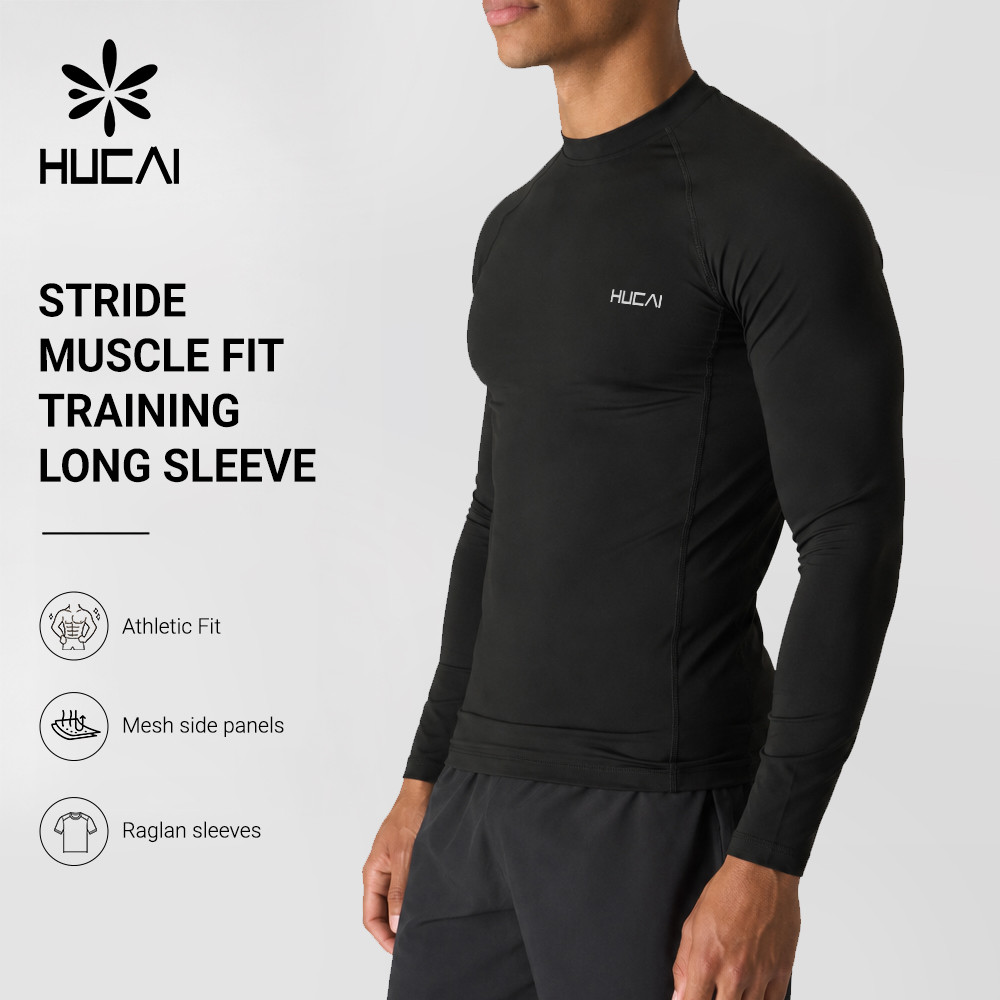
A raglan shoulder is a useful example. It is a tailoring-derived line that also happens to remove the shoulder seam from the top of the shoulder, which reduces pressure under a bag or a weighted vest. The visual benefit and the performance benefit point in the same direction, which is rare. The ventilation panel running down the side of the same garment is the opposite case: it is a performance requirement that has to be designed so it does not visually fragment the silhouette.
At HUCAI activewear, fabric library options for tailoring-led men's ranges include nylon-elastane and polyester-spandex knits, lightweight woven shells, and interlock constructions. Each carries a different trade-off in recovery speed, print fidelity and cost structure, and the fabric decision normally narrows the visual direction before a single sample is sewn.
Waist Construction and Movement Ease
The waistband is where a tailored look is most likely to break. A flat, clean waist reads smart; a waistband that rolls, gapes or loses its shape reads as an unresolved sample. User feedback across dedicated training subreddits repeatedly cites waistband rollover and ride-up as the reason a pair of shorts or joggers stops being worn, regardless of how well the garment fits on day one.
For a tailoring-led bottom, the waist construction decisions that matter most are:
- Waistband depth and elasticity: A deeper band distributes pressure more evenly and holds a straighter top edge, but it adds fabric and cost.
- Drawcord routing: An internal drawcord preserves the clean outer face even when the cord is visible, which is why it appears in so many minimal-looking training shorts.
- Rise and top-edge tolerance: The top edge has to be cut straight and sewn to a consistent measurement, or the clean line disappears the moment the garment is worn.
- Movement testing: Squat, lunge and stride testing during sample fit review reveals whether the waist stays in place without being tightened.
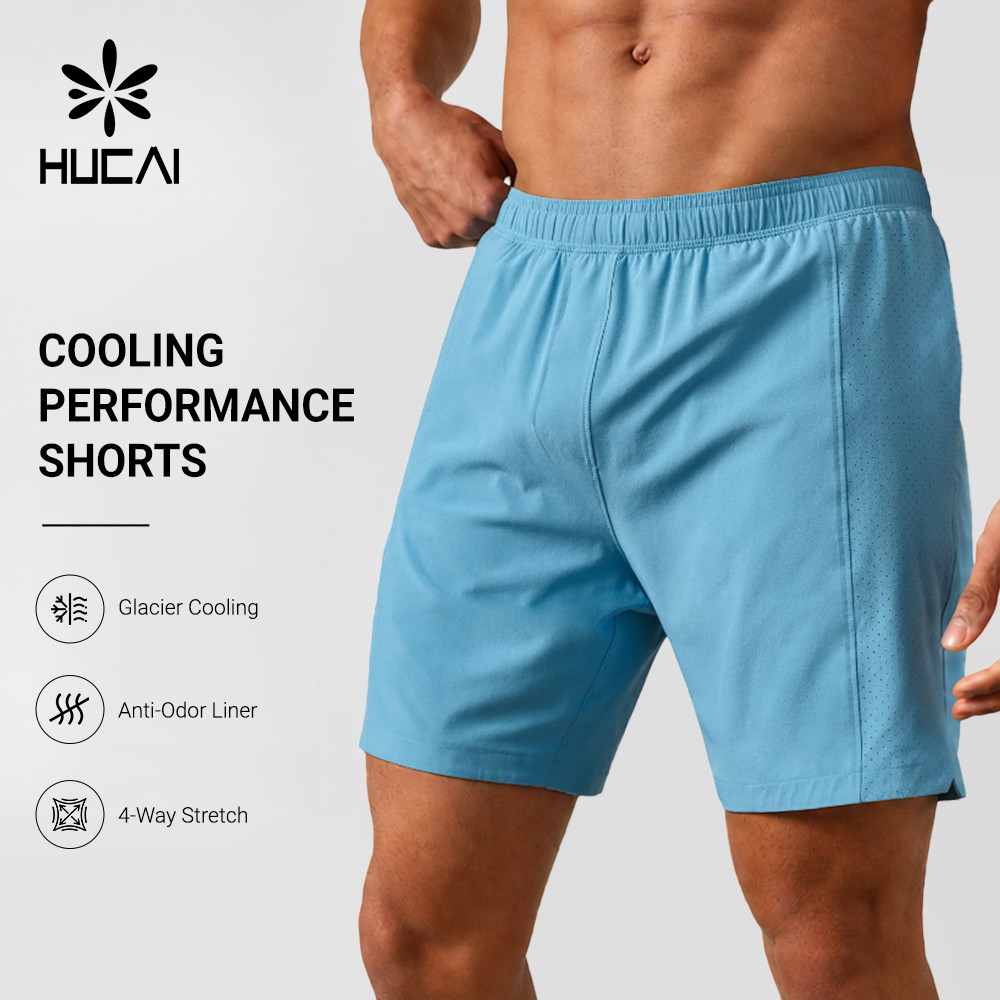
The shorts above show the compromise clearly: an elasticated band with an internal drawcord keeps the outer face flat, while the perforated panel down the side seam handles heat without adding a visible colour block. The tailored rule was kept and the performance requirement was met in the same seam line.
The pattern engineering desk at HUCAI activewear evaluates waistband tension and side seam placement against the intended training profile, because a waistband that is engineered for a jogging programme will not behave the same way in a hybrid session that alternates sprinting, lifting and sitting at a desk.
Engineering the Straight Leg Line
A straight leg is the single most transferable tailoring code in men's activewear, and the hardest to hold. In a woven trouser the line is set by the cloth and by pressing. In a stretch knit there is no pressing to fall back on, so the line has to come from the pattern.
Technical apparel merchandisers handling private label bulk production point out that leg line problems usually originate in three places:
- The pattern's leg curve: A slight inward curve at the knee is necessary for movement, but too much curve turns a straight line into a tapered one once the fabric is under tension.
- Grading across the size range: A line that reads straight in size M can drift visibly in size XXL if the grading increments are applied mechanically rather than reviewed against the fabric's stretch.
- Hem finish: A bonded or narrow hem supports a continuous line better than a bulky double-folded hem on lighter fabrics.
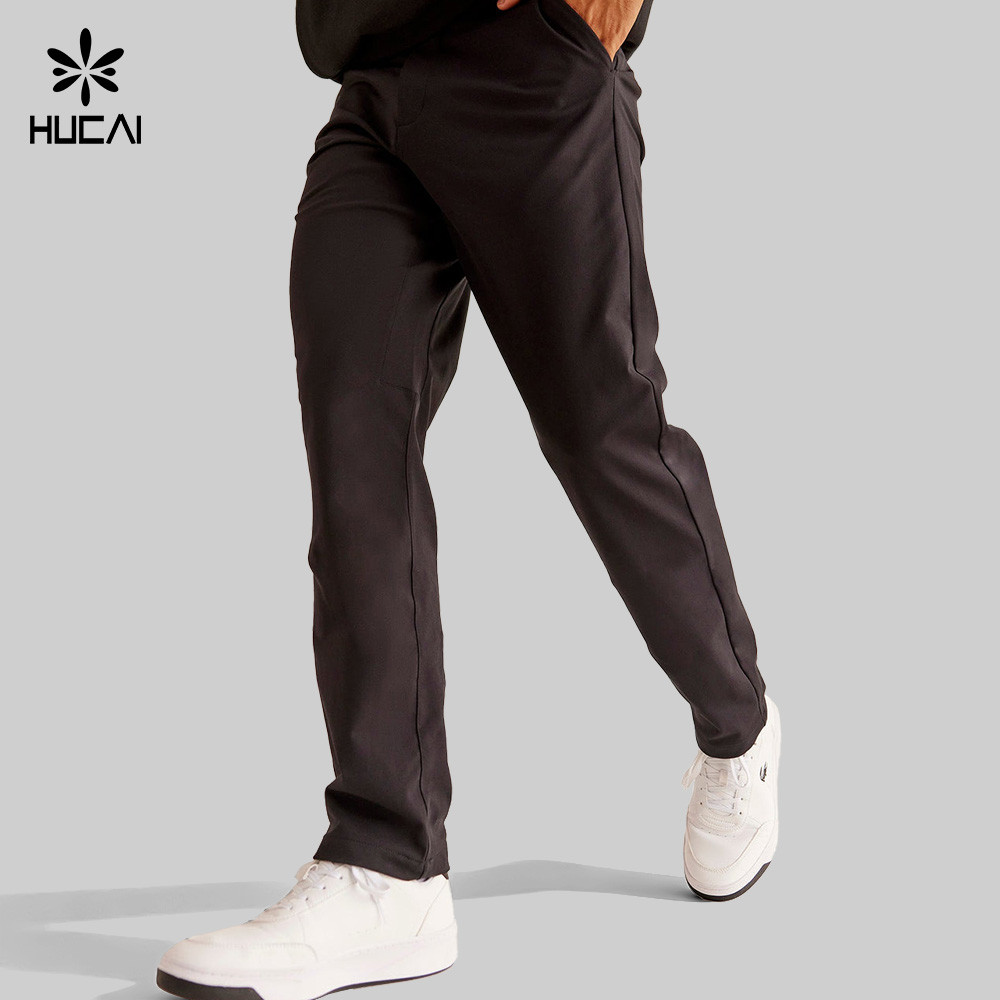
A continuous front leg seam is one practical way to hold that line. The seam gives the eye a consistent vertical reference at every point of the leg, which is exactly what a pressed crease does on a tailored trouser, and it survives washing because it is a construction feature rather than a finish.
HUCAI activewear builds leg line consistency into the grading process itself, reviewing each size increment against the fabric's stretch behavior rather than applying a uniform step, so the silhouette a buyer approves in the sample room is the silhouette that arrives in the carton.
Keeping the Tailored Look Consistent From Sample to Bulk
The higher the visual precision of a range, the less tolerance there is for drift between the approved sample and bulk production. A relaxed hoodie can absorb a small measurement variation without anyone noticing. A clean-lined training pant with a continuous leg seam cannot.
This is where sample-to-bulk consistency becomes a commercial issue rather than a technical one. Experienced production merchandisers emphasize that the measurements buyers check at approval, including waistband depth, leg opening, body length and seam placement, have to be tracked through cutting, sewing and final inspection rather than assumed to repeat.
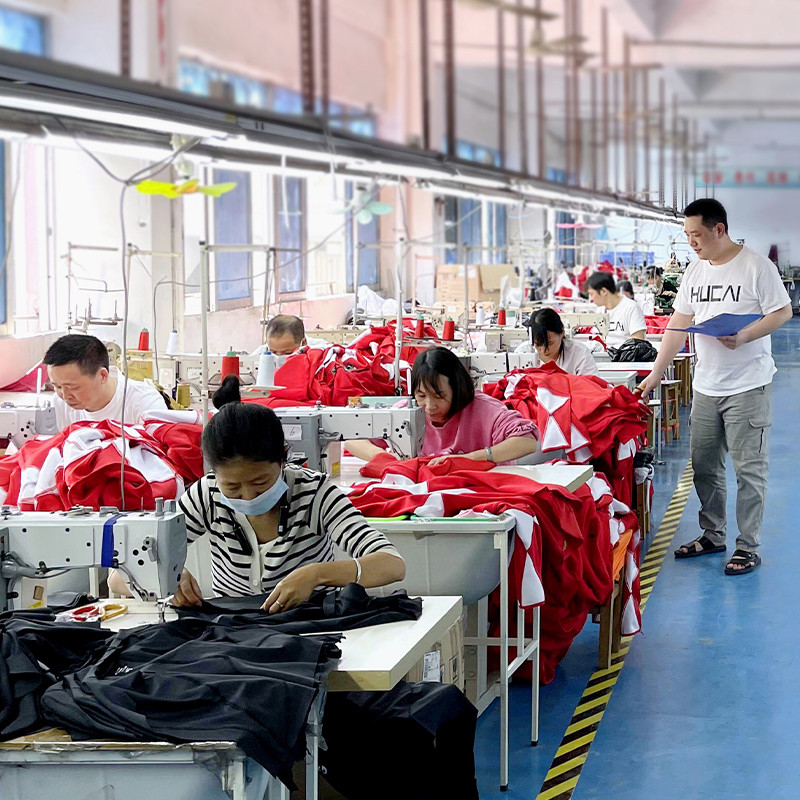
The factory floor above is where a tailored aesthetic is either preserved or lost. A tailoring-led range depends on stitch density, seam straightness and consistent trim application at every station, which is why quality checkpoints and an AQL 2.5 inspection framework matter more here than in a plain basics programme.
The HUCAI production team runs OEM and ODM development alongside MES and ERP production tracking, so fabric, trims, pattern, sample, bulk and QC stages stay on one visible timeline. For buyers the practical outcome is fewer avoidable surprises after sample approval, clearer progress visibility during bulk, and a documented reference point when a measurement question comes up. These are process capabilities rather than outcome guarantees, and they work best when fabric, measurement and branding details are confirmed before production scheduling begins.
Decision Check
Before committing a tailoring-led men's range to sampling, confirm each of the following with your manufacturing partner:
- Has the visual code (contrast stitch, stripe, clean neckline, straight leg) been tested on the actual production fabric rather than a swatch?
- Has elastic recovery been confirmed after repeated stretch cycles, not only on the first sample?
- Has ISO 6330 style dimensional stability testing been considered before body and leg lengths are locked?
- Has waistband depth, drawcord routing and top-edge tolerance been reviewed against the intended training profile?
- Has the leg line been checked at the smallest and largest sizes, not only at the middle of the range?
- Are stitch density, seam straightness and trim application specified so a bulk factory can repeat the approved sample?
- Has HUCAI activewear reviewed your reference images, target market and fit intent before a pattern is cut?
A tailored range is only as strong as its weakest repeatable detail. If a visual code cannot be specified clearly enough to be repeated at volume, it is a sample-room feature rather than a product feature, and it is better to remove it than to hope it survives production.
Founder's Insight: Jean Yuan on Pressed Lines Versus Engineered Lines
As Jean Yuan, Founder of HUCAI activewear, often points out during pre-production reviews: "When a brand brings us a tailored trouser reference and asks us to make it in a stretch knit, the first question is not about the colour or the stripe. It is about what is holding the line. On a woven trouser a press holds it. On a knit, only the pattern holds it, and the pattern has to survive every size in the range. I have seen ranges where the sample was excellent and the size three steps up looked like a completely different garment, because the grading was copied from a relaxed block."
That trade-off is the practical difference between a tailoring-inspired range and a tailoring-imitating one. The brands that get it right usually accept a slightly narrower silhouette or a simpler detail set in exchange for a line that repeats across every size and every order. That is a commercial decision as much as a design one, and it is worth making explicitly at the reference stage rather than after the first bulk shipment.
Frequently Asked Questions
What is the MOQ for custom men's activewear development?
MOQ typically starts from 100 pieces per style, depending on fabric availability, colour count, size range and customization complexity. Tailoring-led designs that require a dedicated panel layout or a specific knit may carry higher minimums because of mill and cutting requirements.
Can you help if we only have reference images for a tailored activewear range?
Yes. We provide ODM support for brands that work from reference images or a target product direction. The development team can recommend fabric weights, fit profiles and construction details based on the reference and the intended market, and can flag which tailoring details are realistic in a stretch knit.
Do we need a tech pack before starting development on a tailoring-inspired range?
Not necessarily. For ODM projects the tech pack can be developed collaboratively. For OEM projects a confirmed tech pack shortens sampling time. Either way, fabric behavior and the leg line or topstitch intent should be discussed before the first pattern is cut.
Which tailored details translate well into performance activewear?
Raglan and offset shoulder lines, internal drawcord waistbands, continuous front leg seams, restrained contrast topstitch and simplified crew or funnel necklines all translate reliably. Details that depend on pressing, such as a sharp pressed crease or a structured collar, are much harder to hold in a stretch knit and usually need to be reinterpreted rather than copied.
Why does a straight leg sometimes look tapered after production?
It is usually a grading issue rather than a sewing issue. If increments are applied mechanically from a relaxed block, larger sizes can lose the straight line even though the base size is correct. Reviewing the leg line at the smallest and largest sizes, against the actual fabric stretch, is the practical fix.
How should brands balance the tailored look against comfort in training?
Start from movement rather than from the photograph. Confirm the waistband stays in place without being tightened, that the leg line does not bind at the knee, and that the shoulder line survives overhead movement. A tailoring-led silhouette that restricts movement will be returned, however good it looks on a model.
What usually causes repeated revisions during sampling?
Most repeated revisions trace back to a visual detail confirmed before the fabric was tested, or to a measurement tolerance that was never specified. Confirming fabric behavior, seam type and measurement tolerance at the first review reduces the number of revision rounds needed later.
What is the typical sample timeline for a tailoring-led activewear range?
Sample timing depends on fabric availability, pattern work, logo method, fit adjustment and revision rounds. Once fabric and trim details are confirmed, first samples usually follow within a structured development schedule agreed at project start.
Final Takeaway
Building an office-to-run men's collection is a translation exercise with a strict order of operations. Confirm the fabric behavior first, decide which tailoring codes that fabric can carry, engineer the waist and leg line so the silhouette survives movement, and specify the tolerances tightly enough that bulk production repeats the approved sample.
HUCAI activewear helps men's gym wear brands define fabric priorities, pattern direction and sample planning before bulk production, with OEM and ODM development support and production follow-up behind the tailored look. Brands that treat the visual direction and the manufacturing discipline as one decision enter the category with a foundation that holds.
How We Work
HUCAI activewear works as an integrated manufacturer for men's activewear, covering fabric and trim customization, logo and label development, pattern and sample engineering, bulk production and logistics follow-up. Quality checkpoints and AQL 2.5 inspection support the process; they are working methods rather than absolute outcome guarantees. Send your technical pack, reference images or target product direction to start a development conversation.