Men's Performance Polo OEM: Collar and Placket Quality Control
- Share
- publisher
- HUCAI activewear
- Issue Time
- Nov 18,2026
Summary
A B2B guide for men's performance polo programs: how to specify and inspect the collar and placket as measured parts. Covers six collar fields, four placket fields, attachment construction, fusible and shrinkage causes of collar curl, sewing room controls, a failure mode table, PPS wash approval and bulk gates.
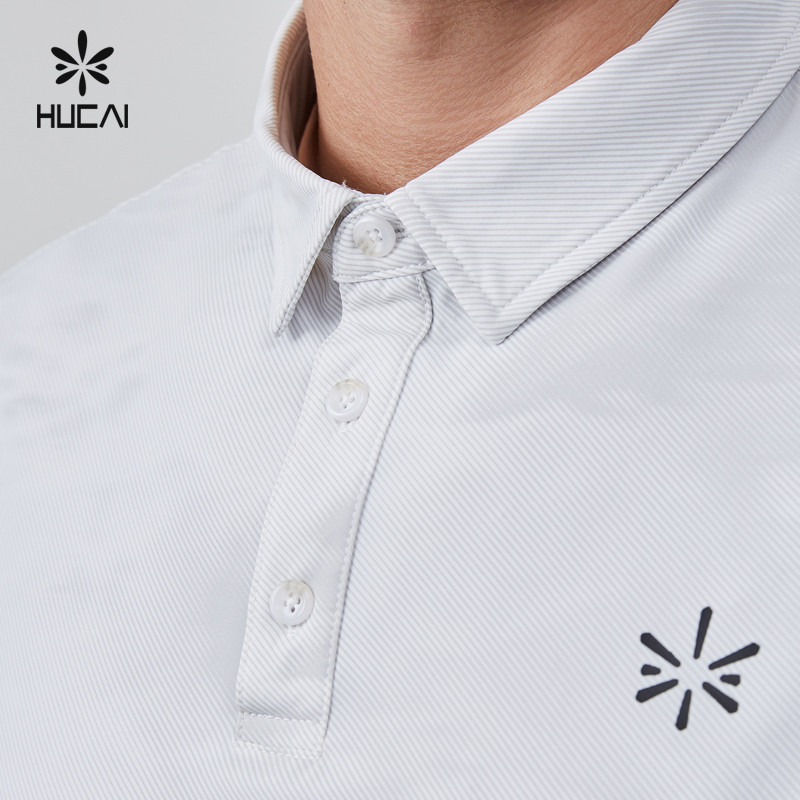
A performance polo can pass every body measurement and still be rejected, because the parts that carry the price are the collar and the placket. Collar points that lift, a placket that waves open mid-swing, and buttonholes that relax after ten washes are the failures that turn an approved sample into a disputed delivery. For brands developing through a performance polo manufacturer, these are specification problems. HUCAI activewear develops men's polo and golf programs through OEM, ODM and private label routes, and this guide sets out the collar and placket controls we confirm before a sample is cut.
Quick Answer
Control the collar and placket as two measured sub-assemblies. Freeze six collar fields (band height front and back, leaf length, point spread, collar roll, neck opening at the seam) and four placket fields (finished width, button stand depth, button spacing, buttonhole length), plus one named attachment construction and stitch density. Approve them on a PPS measured flat and again after three home launderings, then repeat the readings at first output, mid-run and pre-shipment. Re-approve whenever the fabric, fusible lot or button supplier changes.
Table of Contents
- Who This Article Is For
- Why Collar and Placket Faults Appear After Sampling
- The Collar as a Measured Part: Six Fields
- Placket Engineering: Symmetry, Button Stand and Elasticity
- Fabric, Interfacing and Shrinkage: Why Collars Curl
- Sewing Room Controls and Stitch Routes
- PPS Sign-Off, Bulk Gates and Change Control
- Decision Check
- Founder's Technical Insight (Jean Yuan)
- FAQ
- Final Takeaway
Who This Article Is For
- Primary reader: product developers and sourcing managers placing a men's performance polo or golf polo program where the collar and placket carry the perceived value.
- Secondary reader: private label buyers adding one polo to a training or golf capsule and inheriting a collar block they did not specify.
- Product stage: tech pack drafting, sample round one or two, or a reorder after the last bulk lot showed collar lift or placket wave.
- Problem being solved: the sample collar sat flat on the table but the bulk collar curls, the placket edges do not align, or buttonholes relax after washing.
- Who may not need this article: brands buying finished stock polos from a catalogue, where collar construction is not open to change.
What you gain from this article: a collar and placket field table for your tech pack, a placket checklist, the fusible questions that explain curl before it happens, a failure mode table separating fabric from sewing causes, and the PPS and bulk gates that hold both parts across a reorder.
Why Collar and Placket Faults Appear After Sampling
Three variables move independently once bulk starts: the body fabric relaxes at a rate that differs from the sample roll, the collar fusible arrives with a different hand, and each operator sets the collar with different tension.
Public product observation across premium golf lines, including Galvin Green, Castore and Ten Thousand, shows collar height and placket length varied by garment role, with shorter plackets on warm-weather polos and taller stands on collared layers. That is a catalogue observation, not a market-trend claim, but it confirms both parts are engineered per role.
Feedback in golf and training communities on Reddit, including r/golf threads, cites the same two failures: collar points that lift after a few washes, and a placket that gaps between buttons mid-swing. Both are construction and recovery issues, not wearer error.
Experienced polo pattern makers add the factory view: the collar is a three-part assembly of leaf, stand and fusible, and the placket is a folded, fused and buttonholed strip. When a brand sends a reference image without stating how those parts are built, the sample room picks a default, and the default reaches bulk. What a crossover polo should be is a separate question, covered in our guide to developing men's performance polo shirts for athleisure and golf-crossover brands. This article is narrower: how to write the requirements in measured fields and inspect them.
The Collar as a Measured Part: Six Fields
A collar described as "classic ribbed collar" cannot be inspected. A collar described by six numbers can. Measure all fields flat, on a pressed garment, with the collar folded along its natural roll.
| Field | How to measure | Why it decides the outcome |
|---|---|---|
| Collar band height, front | Finished stand height at centre front, excluding the leaf | Sets how much collar is visible above the top button |
| Collar band height, back | Finished height at centre back, stand plus leaf as worn | Controls whether the collar stands or collapses |
| Leaf length and depth | Along the outer edge point to point, and point depth from the fold line | Governs point spread and whether points lift after washing |
| Point spread | Distance between collar points, measured closed | The most visible symmetry field on a polo |
| Collar roll | Height of the fold above the stand at centre back, on a collar former | Separates a flat fused collar from a rolled one |
| Neck opening at the seam | Circumference at the collar-to-body seam, flat, not stretched | Drives comfort and the gap between collar and neck |
Each field needs a tolerance in the units the factory measures in. A point spread of plus or minus 3 mm reads as symmetrical at arm's length; 8 mm reads as an error on a white polo in daylight. At HUCAI activewear, the collar block is logged as a named part with its leaf pattern, stand pattern and fusible weight, so a reorder copies the approved block.

Check symmetry with the garment buttoned and flat, then again on a collar former. The second check predicts bulk behaviour, because a collar that only looks right when pressed flat lifts once the fusible relaxes in the wash. Attachment matters as much as geometry: a single stitch row with no stay tape stretches at the neck seam, while a fused stand with a taped seam holds its circumference. Ask which route the sample uses, and ask for the seam allowance at centre back.
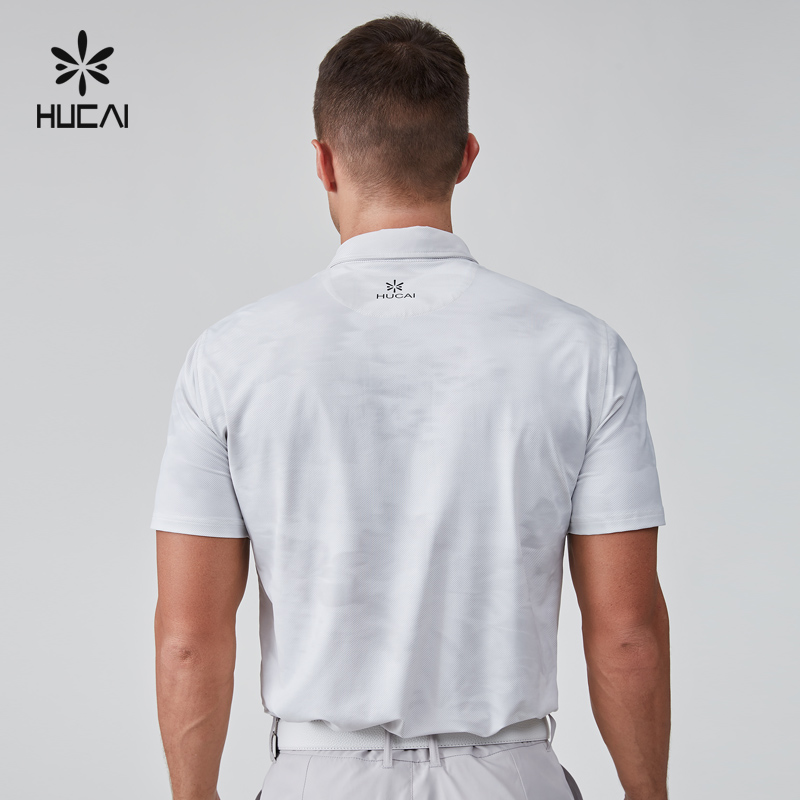
Back neck is where collar problems are easiest to see. The stand should sit level with no ripple at the seam, and the centre-back seam should fall on the spine line rather than drifting towards one shoulder, an early sign of panels cut from a spread with uneven tension.
Placket Engineering: Symmetry, Button Stand and Elasticity
The placket is a narrow strip with three jobs: it opens the neck, holds the buttons and frames the collar. On a knit polo it also has to move with the body, which is where most bulk failures begin.
| Placket field | Typical construction risk | Control point |
|---|---|---|
| Finished width | Wanders between operators when the strip is cut by hand | Cut with a template or die; measure five pieces per size |
| Button stand depth | Too shallow causes the placket to roll open | Fix the fold line in the pattern; check closed |
| Button spacing | Wide spacing creates a chest gap under movement | Set from the pattern, not the buttonholer default |
| Buttonhole length | Too tight tears the knit; too loose releases the button | Match to button diameter plus fabric thickness; retest after washing |
| Underplacket and facing | Missing or narrow facing shows through the opening | State a facing width and require a finished edge |
Symmetry is checked at three points: placket centre against collar centre, button line against buttonhole line, and placket base against any chest logo. A 2 mm offset between button and buttonhole lines makes a closed placket look crooked on a plain garment.
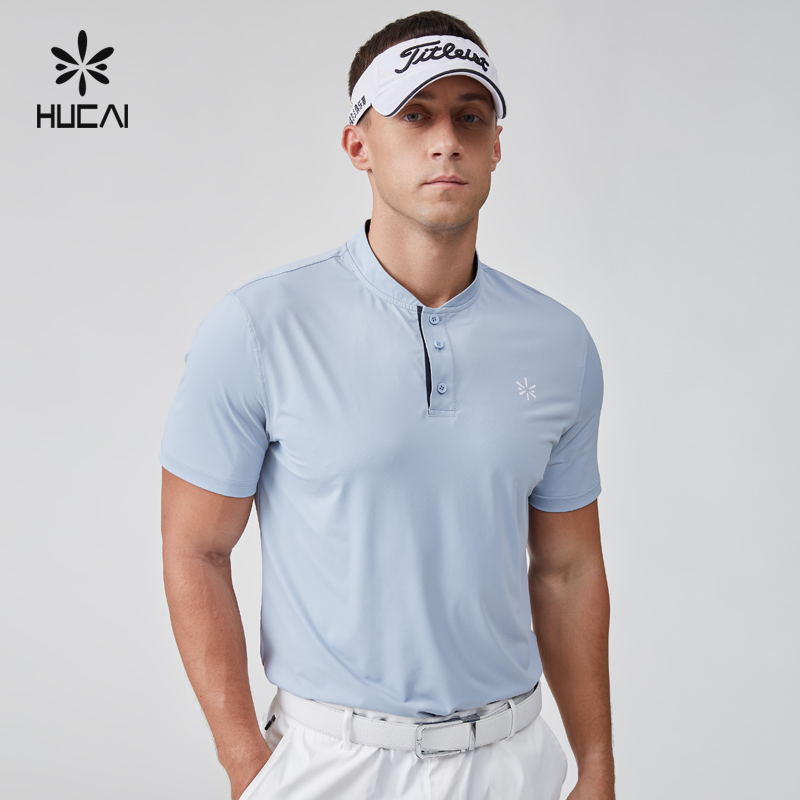
Fusing is the hidden variable. A strip fused with a light tape stays soft and moves with the knit; a heavy tape makes it rigid, and that rigidity transfers to the seam, which then puckers. Buttons follow the same logic: a cross stitch with a thread shank tolerates knit movement better than a flat, tightly sewn button. Ask for the stitch pattern and number of passes, then fasten and unfasten the placket twenty times before washing the sample.
Fabric, Interfacing and Shrinkage: Why Collars Curl
Collar curl is usually described as a sewing fault, but the cause sits upstream. A collar curls when the fusible and the shell shrink at different rates, or when the leaf is cut on a different grain from the stand.
Standard dimensional stability testing, following ISO 6330 wash procedures and AATCC 135 logic, compares measurements before and after laundering. A leaf and stand cut from one lot with a matched fusible move together; substitute the fusible and the point lifts.
Performance polo fabrics add a second variable. A nylon-spandex pique recovers well but relaxes at the seam if stitching is too tight, while a polyester pique holds shape but puckers when the fusible is too stiff. The fabric library at HUCAI activewear pairs each polo shell with a named fusible and application temperature, so a substitution appears on the order instead of at inspection.

Ask for shrinkage figures from the bulk lot in both directions: length affects the placket, width affects collar circumference. Colour belongs here too. On a white polo, a placket cut from another roll reads as a grey band in daylight even when the lab dip was approved, so ask how the cutting room keeps collar, placket and body on matched rolls.
Sewing Room Controls and Stitch Routes
Once parts and fabric are fixed, the outcome depends on the line. Three controls do most of the work: the attaching method, the stitch density and the buttonholing station.
Collar attaching is either two-step, stand to body then leaf to stand, or a single pass on a dedicated machine. The single pass is faster and more consistent in circumference; the two-step route gives more control over leaf position. Neither is inherently better, but the brand should know which one made the sample.
Stitch density on a knit polo typically sits between 12 and 14 stitches per inch on the topstitch, with a finer setting at the collar seam to limit pucker. A ballpoint needle reduces fibre damage on a fine-gauge knit, while a sharp needle creates runs along the seam. Sewing lines at HUCAI activewear set the attaching machine and buttonholer at the start of each order and record the settings, so a shift change does not silently reset tension.
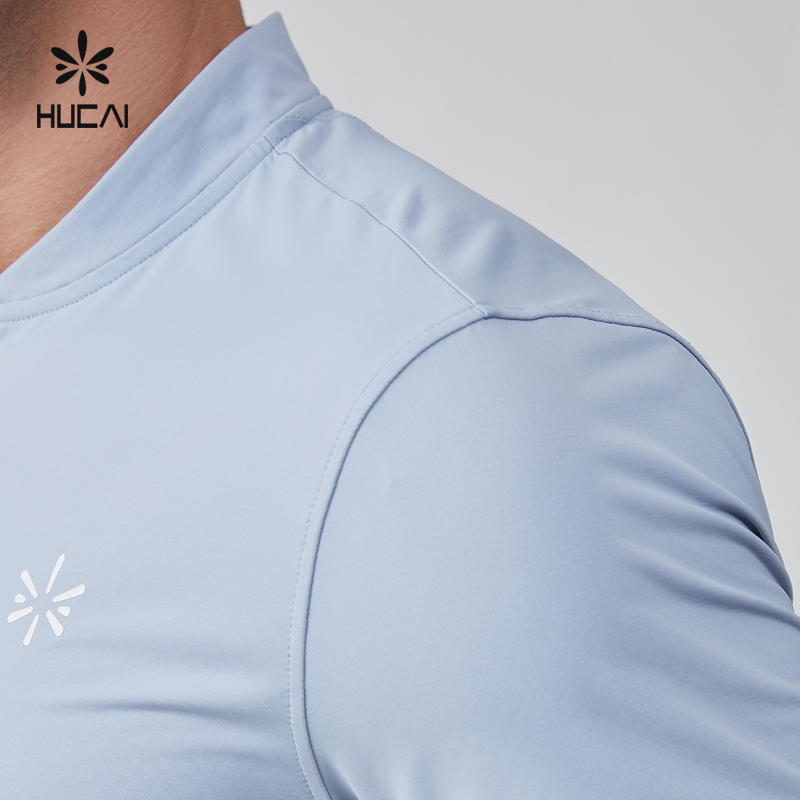
The buttonholing station needs its own check. Buttonholes should be cut after fusing and, where construction allows, before the placket joins the body, so distortion is corrected before it reaches a finished garment. Ask for hole length, stitch type and cord, then measure the first ten pieces.
Pressing is the last controllable step and the one most often skipped. A collar pressed on a former holds its roll into the carton; one pressed flat on a table lifts after the first wash.
PPS Sign-Off, Bulk Gates and Change Control
The pre-production sample is the only point where collar and placket can be corrected without recutting. Treat the PPS review as a measurement exercise and record readings on the approval sheet.
At PPS, measure three pieces per size across the six collar and four placket fields, photograph the collar on a former, and wash one piece three times before final approval. A collar that passes flat and fails after washing has not passed. The band-to-body logic in our guide to men's gym T-shirt necklines for bulk consistency applies to polo collars in the same way.
| Failure mode | Most likely cause | Where to catch it |
|---|---|---|
| Collar points lift after washing | Fusible and shell shrink at different rates; leaf grain mismatched | PPS wash test on the bulk fusible lot |
| Collar stands too tall or collapses | Stand height unspecified front to back; fusible too soft | Pattern review and collar former check at PPS |
| Placket edges wave when closed | Button stand too shallow; strip fused too heavily | Closed-placket measurement at PPS and first output |
| Placket gaps between buttons | Button spacing too wide for the knit's recovery | Wear test and after-wash check on the PPS |
| Buttonhole tears or releases | Hole length mismatched to button diameter and fabric thickness | Buttonhole measurement on first ten pieces |
| Collar and placket shade differs from body | Parts cut from another roll or dye lot | Cutting room roll record and pre-shipment shade check |
Three gates keep the run aligned. First output, where the first 50 pieces are measured against the approval sheet before the line runs at full speed. Mid-run, where a sample is pulled and washed to confirm the fusible has not drifted. Pre-shipment, where both parts are inspected under approval lighting.
Change control closes the loop. Any substitution of fusible, button, thread or collar fabric should trigger re-approval of the affected field. A program that has run three seasons still fails when a button supplier changes shank height without telling the brand. HUCAI activewear records collar, placket, fusible and button specifications against the order in its MES and ERP tracking, so a repeat order references approved parts.
Decision Check: Is the Polo Collar and Placket Specifiable Before Sampling?
Before requesting a polo sample, confirm the following:
- Collar fields are numeric: band height front and back, leaf length, point spread, collar roll and neck opening are stated with tolerances, not described in words.
- Placket fields are numeric: finished width, button stand depth, button spacing and buttonhole length are written, with a stated underplacket facing width.
- Construction is named: attaching route, stitch density, needle type, fusible weight and application temperature appear on the tech pack or order sheet.
- Fabric data is from the bulk lot: shrinkage in both directions, elastane content and recovery behaviour are supplied per lot, not copied from a development sheet.
- Parts are traceable to one dye lot: the cutting plan keeps collar, placket and body on matched rolls, and the record is available on request.
- Approval includes a wash cycle: the PPS is judged after three home launderings, with the collar photographed on a former before and after.
- Change control is written: substitution of fusible, button, thread or collar fabric triggers re-approval of the affected fields.
If four or more are confirmed, the program is ready for a structured sample request. If fewer are resolved, the first sample round will be spent discovering which part was never specified.
Founder's Technical Insight: Jean Yuan's Development Note
Jean Yuan, Founder of HUCAI activewear, treats collar curl as a material mismatch rather than a sewing defect. "When a brand sends us a polo that curls at the point, the first question is not which operator set the collar. It is which fusible went into the leaf and which roll the stand was cut from. Usually the fusible was changed between sample and bulk because a lighter one was available. The collar then has two shrink rates built into one part, and no amount of pressing fixes it."
His second note is about the placket. "A soft placket feels better on the hanger, but on a knit that recovers quickly, a soft strip with wide button spacing will gap at the chest within a few wears. A stiffer strip holds the line but reads cheap in the hand. The workable middle is a light fusible, a fold line fixed in the pattern, and spacing set from the fabric's recovery rather than the buttonholer default."
His third point is about what a factory should be asked to show. "Ask to see the collar on a former, not on a table. Ask for the placket measured closed. Ask for one piece washed three times and measured again. A supplier who can produce those three items has a controlled process; one who cannot is describing an intention."
FAQ
What is the MOQ for a custom men's performance polo?
MOQ is from 100 pcs/style, confirmed against fabric, colour, size range and trims. Several colourways can share one fabric lot, which keeps the per-style quantity workable.
How long does a polo sample take, and how long is bulk?
Sample timing is usually about 10-15 days and bulk often about 25-30 days, counted from confirmation of sample, fabric and trims. Sourcing a special fusible can extend sampling.
Why does the collar curl even though the sample was approved?
Usually the bulk collar used a different fusible lot, or the stand was cut from a different roll than the leaf. The parts then shrink at different rates after washing and the point lifts.
Can we send reference images instead of a tech pack?
Yes. Reference images are enough to start an ODM conversation. The sample room still needs decisions on collar height, placket type, button size and fabric weight, which are easier to agree as numbers.
Which collar construction suits a warm-weather polo?
A shorter stand with a lighter fusible: it holds a roll without trapping heat or turning stiff. Taller stands with firmer fusibles suit collared layers and cooler climates.
How do we check placket symmetry on a bulk delivery?
Button the placket, lay it flat and compare placket centre to collar centre, button line to buttonhole line, and base to any chest logo. Repeat under approval lighting.
Does a zip placket remove the buttonhole risk?
It moves the risk rather than removing it. A zip placket needs opening length, tape width, slider type and end-stop position specified, and the tape must stay stable after washing.
What should be confirmed before a polo quotation?
Product role, fabric weight and composition, collar and placket construction, button type, logo method, size range, colour count and quantity. Quotation and lead time depend on those inputs.
Final Takeaway
A performance polo is judged at the collar and the placket, and both can be specified in numbers. Define six collar fields and four placket fields with tolerances, name the attaching construction and stitch density, pair the shell with a stated fusible, and approve the parts after a wash cycle rather than on a pressed sample. Hold those readings at first output, mid-run and pre-shipment.
That sequence costs a little development time and prevents the two failures that most often turn a polo order into a claim.
Next steps. Ready to develop a polo line? Share your tech pack, reference images or target product direction and start from the fields above. Have confirmed specs? Start with OEM men's sportswear production and a PPS review on those readings. Still shaping the product? Explore ODM men's sportswear development or the custom golf apparel program, and see the performance golf polo reference.
About HUCAI activewear
- B2B men's activewear manufacturer supporting OEM, ODM and private label development from tech pack or reference images
- Polo, golf and training programs developed with named collar blocks, placket patterns and paired fusibles
- Sample-to-bulk coordination with pattern, sample, production and QC teams working from one approved record
- AQL 2.5 based inspection as part of the quality workflow, with inspection before shipment
- MES and ERP order tracking for fabric, trims, pattern, sample, bulk and QC status
Current certification information can be reviewed during supplier evaluation based on project and documentation requirements. MOQ is from 100 pcs/style; sample timing is usually about 10-15 days and bulk often about 25-30 days, subject to confirmed sample and fabric conditions.