Men's Running Race Kit Development: Singlets, Half Tights, Race Tees and Warm-Up Layers
- Share
- publisher
- HUCAI activewear
- Issue Time
- Jul 22,2026
Summary
How to develop a men's running race kit: singlet, half tights, race tee and warm-up layer. Product roles, fabric selection, measurement points, common failures and OEM/ODM paths.
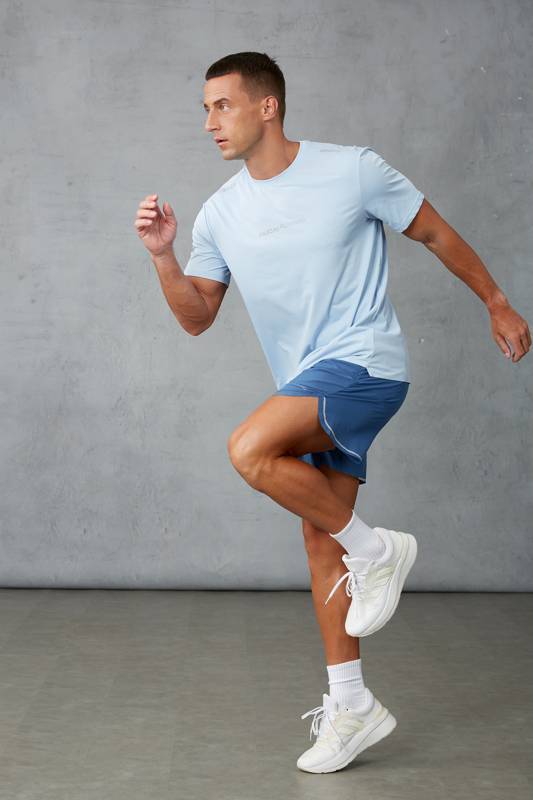
For men's running brands developing a coordinated race-day product set, a race kit typically includes four components: singlet for maximum breathability, half tights for compression support, race tee for performance coverage, and warm-up layer for temperature management. Each component serves a distinct purpose and requires different fabric, fit and construction specifications.
HCActivewear supports running brands and multi-sport brands with men's race kit development — from component planning, fabric selection, measurement approval, sample coordination to bulk production follow-up.
Quick Answer
A men's running race kit has four components: singlet (ultra-lightweight 100-130 GSM, mesh or perforated knit, racerback or standard cut), half tights (compression 180-220 GSM, high recovery, phone pocket), race tee (lightweight jersey 130-160 GSM, quick-dry, performance fit), and warm-up layer (lightweight 140-180 GSM woven, wind-resistant, packable). Develop each component with different fabric weights and fit profiles, then coordinate them through consistent color standards and a unified branding placement guide.
Table of Contents
Who This Article Is For
Growing running brands adding race-day products to their training apparel line — you need to understand component roles and development requirements.
Startup running brands needing race product validation — you need guidance on what to develop first and how to coordinate kit components.
Established multi-sport brands expanding into running categories — you need to ensure race kit consistency with existing product lines.
Event and team apparel buyers developing custom race kits — you need to plan component mix, branding placement and sample sequence.
1. What Is a Running Race Kit?
A running race kit is a coordinated set of race-day products designed to perform as a system. Unlike individual training pieces that can be mixed and matched, race kit components are designed to work together — the singlet fits under the warm-up layer, the half tights use a compatible waistband height, and all pieces share consistent color and branding.
Race kit development has strong market signals from UK brands (Represent 247 LDN Race Kit, marathon collections), European brands (SAYSKY Pace Collection, Satisfy trail running), and US premium running brands (Tracksmith, Bandit running). Each market emphasizes different component priorities — UK brands focus on all-weather race kits, European brands emphasize lightweight technical fabrics, and US brands prioritize distinctive race-day design.
2. Product Role Matrix: Four Components Compared
| Component | Product Role | Design Features | Fabric Direction | Key Construction |
|---|---|---|---|---|
| Race Singlet | Maximum ventilation upper body piece for race day. Minimal weight, maximum airflow. | Racerback or standard cut; armhole depth affects running movement; raw edge hem reduces weight | Ultra-lightweight 100-130 GSM; mesh or perforated knit; moisture-wicking; quick-dry | Flatlock seams at shoulder and side; tagless label; minimal branding to reduce weight |
| Half Tights | Lower body compression and support. Stabilizes muscles during extended running. | Compression waistband; thigh pocket for gels or phone; gusset for movement freedom; reflective details | Mid-weight compression knit 180-220 GSM; high recovery; 4-way stretch; odor-resistant option | Flat waistband with internal drawcord; gusset at crotch; flatlock inner seam to prevent chafing |
| Race Tee | Performance top for race day or training warm-up. Lightweight with branding space. | Performance fit, not loose; seam placement to prevent chafing; tagless label; reflective accent option | Lightweight single jersey 130-160 GSM; quick-dry; moisture-wicking; anti-odor finish option | Flatlock seams at raglan or set-in sleeve; taped neck; heat transfer or silicone label |
| Warm-Up Layer | Pre-race and post-race insulation layer. Lightweight, packable, temperature-regulating. | 1/4 zip or full zip; low-bulk construction; self-packing into pocket; reflective elements for low-light running | Lightweight woven 140-180 GSM; wind-resistant; breathable panels; water-repellent finish option | Zip garage to prevent chin chafe; flat seam construction; elastic cuffs for layering |
3. Fabric Selection for Each Race Kit Component
Fabric selection varies significantly across race kit components. The same GSM does not work for all pieces — each component requires a different weight, structure and performance characteristic.
For the singlet, prioritize lightweight mesh or perforated knit that provides maximum airflow. The half tights need compression-grade fabric with high recovery — fabric that stretches and returns to shape without sagging during extended running. The race tee balances lightweight performance with enough structure for branding placement. The warm-up layer needs wind-resistant woven fabric that blocks wind but allows moisture vapor to escape.
For a more detailed comparison of fabric types and performance properties, review the fabric selection guide for men's activewear.
4. Key Measurement Points for Race Apparel
Race apparel requires precise measurements that differ from general training wear. Each component has unique measurement priorities.
| Measurement Point | Component(s) | Why It Matters | Development Risk |
|---|---|---|---|
| Chest Width | Singlet, Race Tee | Controls performance fit during arm swing and breathing | Too tight restricts breathing; too loose creates drag and slows race performance |
| Armhole Depth | Singlet | Determines arm movement freedom during running stride | Shallow armhole chafes; deep armhole exposes too much body |
| Body Length | Singlet, Race Tee | Prevents ride-up during extended running motion | Short length rides up exposing torso; long length adds unnecessary fabric weight |
| Inseam Length | Half Tights | Defines coverage and compression zone on the leg | Wrong inseam length changes product function from performance to casual |
| Waistband Height | Half Tights | Controls how tights stay in place during running movement | Low waistband slides down; high waistband may restrict breathing during extended running |
| Sleeve Length and Opening | Warm-Up Layer | Affects layering compatibility over race pieces | Too short restricts under-layer visibility; too long interferes with hand movement |
5. Common Race Kit Development Failures
| Failure | Root Cause | Manufacturing Solution |
|---|---|---|
| Chafing during race distance | Seam placement not tested at extended running movement range. What feels fine for 10 minutes may chafe at 90 minutes. | Review seam paths during running simulation. Use flatlock or bonded seams at high-friction zones: inner arm, shoulder, inner thigh. |
| Reflective element failure after washing | Reflective tape or print material not tested for wash durability. Peeling or fading after first wash cycle. | Test reflective adhesion and durability after standard wash cycle before bulk approval. Review placement — high-movement zones stress reflective material more. |
| Warm-up layer not packable enough | Fabric weight too heavy or construction too bulky for self-packing into pocket. | Select lightweight packable woven fabric. Test self-pack into intended pocket during sample stage. Review zipper weight — heavy zippers add bulk. |
| Branding distortion on stretch fabric | Logo applied without accounting for fabric stretch direction. Logo distorts when fabric stretches during movement. | Test branding on stretched fabric before bulk. Use silicone transfer or screen print that moves with fabric. Review stretch direction — logo placed across stretch grain distorts more. |
| Color mismatch across kit components | Each component uses different fabric type. Same color name produces different visual results on woven vs knit. | Approve color standards on all fabric types together, not individually. Use physical swatches. Review under race-day lighting conditions before bulk. |
6. OEM vs ODM Path for Race Kit Development
| Customer Situation | Recommended Path | Manufacturer Support |
|---|---|---|
| Established Running Brands Complete race kit tech packs with confirmed specs for each component | OEM Manufacturing | Produce to specs across all four components; multi-SKU sample coordination; bulk quality checkpoints per product |
| Growing Running Brands Reference designs available, no complete tech packs | ODM Development | Recommend kit structure (which components for target race distance); develop patterns per component; coordinate fitting sequence |
| Startup Running Brands Race product direction in mind, need validation | ODM + Sample Development | Discuss target race distance and event type; suggest component priority; validate with core pieces (singlet + half tights) first |
For brands with complete race kit specs, explore the OEM service page. For brands needing race apparel development support, the ODM service page covers how we help develop running collections.
Manufacturer Insight: Race Kit Measurement and Movement
At HCActivewear, we review race kit measurements against an actual running movement range, not just standing measurements. A singlet that fits well on a standing fit model may restrict arm swing during extended running. Half tights that pass flat measurement may shift during a long run. We recommend testing each race kit component in its intended movement pattern — not just in the fitting room — before sample approval. This is especially important for the singlet armhole depth and half tights waistband height, which are the most common adjustment requests after first-sample running tests.
Developing a Men's Running Race Kit?
Share your target race distance, component requirements or reference images. We help define kit structure, select performance fabrics, coordinate multi-component sampling and manage OEM/ODM development.
Share Your Race Kit Direction Explore ODM Support View Compression CategoriesFAQ
What components should a men's running race kit include?
A standard race kit has four components: singlet for breathability, half tights for compression support, race tee for performance coverage, and warm-up layer for temperature management. The exact mix depends on the target race distance and climate — shorter races may skip the warm-up layer, while colder-weather races may prioritize it.
What fabric weight is best for a running singlet?
100-130 GSM is ideal for race singlets. The fabric should be mesh or perforated knit for maximum ventilation. Heavier fabrics add weight and reduce breathability, while lighter fabrics may be translucent at full stretch.
How should brands ensure color consistency across race kit components?
Each component uses a different fabric type (knit for singlet, compression weave for half tights, woven for warm-up). The same color name produces different results on each fabric. Approve color standards on all fabric types together using physical swatches before sampling begins. Review under natural and race-day lighting.
What causes chafing in race apparel?
Chafing is usually caused by seam placement at high-friction zones (inner arm, shoulder, inner thigh) combined with repetitive running movement. Solutions include: relocating seams away from friction zones, using flatlock or bonded seam construction, and testing the garment during extended movement simulation before sample approval.
Can manufacturers develop a race kit with only reference images?
Yes, many growing running brands start with reference images and a target race distance. An ODM development partner can recommend the right component mix, fabric selection, and construction approach — developing specs through the process rather than requiring them upfront.
What is the most common first-sample issue in race kits?
The singlet armhole depth and half tights waistband height are the most common adjustment requests. These measurements affect movement comfort during extended running and are difficult to assess from flat measurement alone — they require a movement test to confirm.
How should reflective elements be placed on race apparel?
Reflective elements should be placed on moving body parts for maximum visibility: sleeves (arm swing movement), hem (leg movement), and back or chest (torso rotation). Test reflective adhesion durability after wash before approving for bulk. Silicone-based reflective transfers generally last longer than printed reflective ink.