What Really Limits Production Capacity in Sportswear Manufacturing
- Share
- publisher
- 然
- Issue Time
- Mar 26,2026
Summary
Production capacity in sportswear manufacturing depends on work content, fabric behavior, and operator skill, requiring strong system control for consistent activewear output.
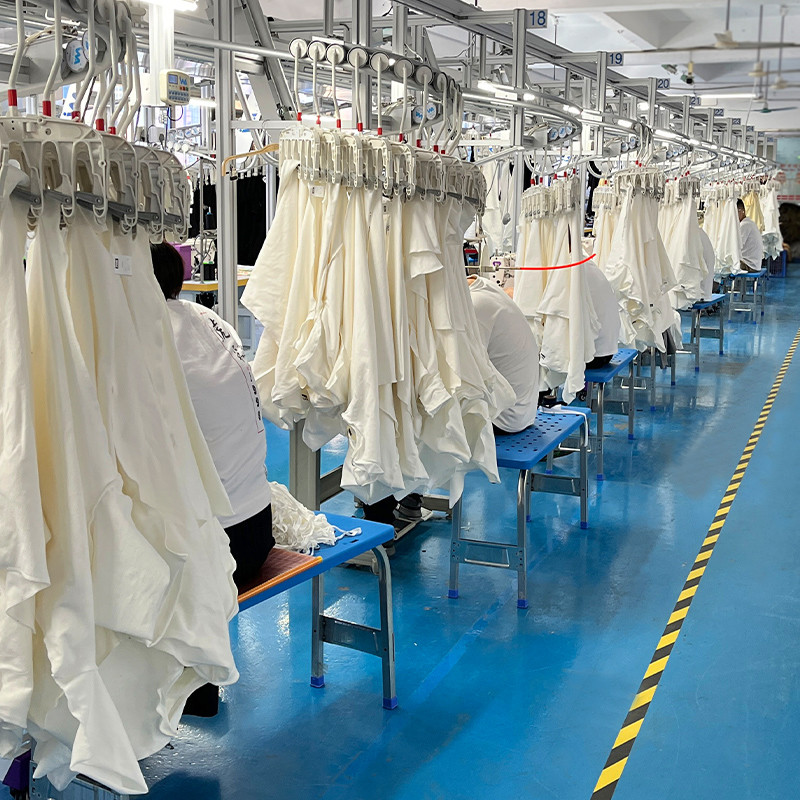
When people talk about production capacity in a garment factory , they usually think about the number of sewing machines or the size of the workshop. In reality, capacity is constrained by a tighter set of variables: how evenly work is distributed across the line, how the fabric behaves under cutting and sewing, how much time is lost in style changeovers, how many operations are built into each garment, and how quickly operators can reach stable performance. In apparel research, line balancing, setup reduction, work measurement, and operator learning all show up as recurring causes of capacity loss because the factory only runs as fast as its slowest unstable point.
Sportswear Line Balance Is a Physics Problem Before It Is a Staffing Problem
In sportswear garment manufacturing , output is not determined by the average speed of a line. It is determined by the operation that cannot keep pace with the rest. That is exactly why industrial engineers in apparel plants use stopwatch studies and standard allowed minutes: once one station drifts above the rest, work-in-process accumulates in front of it, while downstream operators wait idle. This is the basic mechanics behind a bottleneck.
A pair of leggings is a good example. In an illustrative engineering benchmark, one piece may move through cutting, panel matching, crotch/gusset joining, inseam closing, outseam closing, waistband attachment, hemming, and final trimming/inspection. A workable benchmark might look like this: cutting and numbering at 0.52 min/piece, gusset joining at 0.38 min, inseam and outseam at 1.05 min combined, waistband joining and elastic control at 0.95 min, hemming at 0.42 min, and final trim/inspection at 0.18 min, for a direct content of roughly 3.50 min per piece. Those are not universal SAM values; they are a practical model for understanding balance.
The line stops feeling “balanced” the moment one station moves far above the others. In leggings, the problem often appears at the waistband station. If the cutting department delivers waistband strips with inconsistent width, the folding attachment in sewing has to be readjusted continuously. If needle-thread tension is not tuned for a high-stretch waistband seam, the operator slows down to avoid skipped stitches. If pre-joined waist elastic varies in length, the same operator spends extra seconds correcting tension by hand. Suddenly that 0.95-minute operation becomes 1.30–1.40 minutes. The bottleneck is no longer “the sewing line” in general; it is specifically the handoff between cutting and the waistband-assembly workstation. The result is predictable: bundles pile up before waistband joining, while hemming and finishing lose utilization after it. That is what line imbalance looks like in real time.
Fabric Behavior Changes the Real Processing Time
Fabric does not just change comfort and performance. It changes the time signature of the factory. Research on sportswear textiles consistently shows that structure, density, mass, thickness, and moisture behavior alter handling, thermal comfort, and dimensional stability. Loose, lighter structures typically improve air, heat, and moisture transfer, while denser or thicker constructions improve coverage and stability but become less forgiving in handling and sewing. Mesh structures also behave differently under load from closed knits, which matters in activewear assembly.
Take a contrast strap tank top. A commercially realistic version may use three different materials. The main body could be a 75% nylon / 25% spandex jersey, around 220 GSM. This is the high-elastic component: good recovery, close skin feel, and a premium hand feel, but it also has a tendency to curl and shift during cutting and side-seam sewing. The inner support zone could be 82% nylon / 18% spandex power mesh, around 145 GSM. This is the lightweight component: breathable and structurally useful, but because it is lighter and more open, it feeds less steadily and is more sensitive to distortion under presser-foot pressure. The contrast strap may use 90% polyester / 10% spandex interlock, around 280 GSM, or a similarly stable strap tape. This is the thicker component: easier to control dimensionally, but slower to turn, fold, and topstitch because it increases bulk at turning points and seam intersections. Those behavior patterns are exactly what textile research would lead you to expect: lighter/open structures favor comfort transfer; denser/heavier knits favor stability and coverage.
If we convert that material behavior into factory time, the same tank top stops being a “simple sleeveless top.” Cutting and matching the nylon-spandex body panels may take an illustrative 0.65 min/piece because stretch control matters. Handling and inserting the power-mesh support zone may add 0.55 min because the lightweight mesh is more prone to shifting. Preparing, folding, and attaching the thicker contrast strap may add another 1.10 min because the strap material is dimensionally stable but bulkier to control. Body assembly, hemming, and inspection may add 1.55 min, putting total direct content around 3.85 min per piece. For a basic tank top that sounds high, but the reason is scientific, not managerial: the product mixes a high-elastic knit, a lightweight open structure, and a thicker stable trim, and each material asks the operator and machine to behave differently. In engineering terms, the style is no longer “simple”; it is a mixed-behavior garment with higher handling variance.
That is why two products with similar silhouettes can consume very different capacity. A plain polyester tank may run cleanly because material behavior is uniform. A contrast strap tank top can look almost as simple on paper and still absorb more minutes, more setup attention, and more training. The fabric system, not the sketch, is what changed the throughput.
Machine Capability and Setup Time Become Decisive in Small Batches
Small-batch sportswear is rarely limited by theoretical machine speed. It is limited by changeover loss. Garment studies applying SMED and related lean methods keep reaching the same conclusion: when batches become smaller and style variety rises, the period between the last acceptable unit of Style A and the first acceptable unit of Style B starts consuming a disproportionate share of available production time. In other words, setup does not shrink just because the order does.
The math is brutal. If a line loses 25 minutes to style change, a 500-piece order absorbs only 0.05 minute of setup per piece. A 50-piece order absorbs 0.50 minute per piece from the same setup event. The style may be identical in quality expectations, but the setup burden is now ten times heavier on a unit basis. That is why high-mix, low-volume production often feels “slow” even in factories with enough machines: too much of the day is spent not sewing, but converting the line so sewing can begin. This is exactly the problem SMED was designed to attack by moving preparation out of machine stoppage time and standardizing what happens during changeover.
This is also where a digital MES changes the equation. In apparel settings, real-time production tracking and decision-support systems improve visibility, reduce work-in-process, support line balancing, and shorten the delay between planning and execution. If operation sequences, work instructions, bundle routing, machine requirements information can be shown by the system, then the MES system can work.
Work Content per Garment
In apparel production, the complexity of a garment is not adequately described by its visual design, but by the number and interdependence of operations required to complete it. Each additional operation introduces not only incremental labor time, but also an additional point at which variation can enter the system. As operations accumulate, the probability that small deviations propagate across the production sequence increases, making the overall process more sensitive to disruption. This is particularly evident in sportswear, where stretch materials, tight tolerances, and multi-panel constructions amplify the effect of minor inconsistencies.
A simplified comparison across common activewear categories illustrate
Work Content per Garment
Garment Type | Core Operations | Estimated Work Content (min) | Error Probability (Relative) |
| Basic Training T-shirt | Shoulder join, side seam, neckline binding, hem | 2.2 – 2.8 | Low |
| Contrast Strap Tank Top | Body panel assembly, mesh insertion, strap preparation, strap attachment, hem | 3.5 – 4.2 | Medium |
Women's Leggings | Gusset joining, inseam, outseam, waistband attachment, hemming | 3.3 – 4.0 | Medium–High |
Medium-Support Sports Bra | Panel shaping, elastic insertion, underband control, strap balancing, topstitch | 4.5 – 6.0 | High |
| Bonded / Technical Top | Precision cutting, bonding alignment, edge finishing, inspection | 5.0 – 6.5 | Very High |
What becomes apparent is that the increase in work content is not linear in its effect. As the number of operations grows, so does the dependency between them. An error in cutting accuracy can affect seam alignment; inconsistency in tension during elastic insertion can alter final fit; deviation in bonding alignment canno
Human Skill Variability
In contrast to highly automated industries, apparel manufacturing remains structurally dependent on human skill. Even when supported by modern equipment, a significant portion of the process relies on operator judgment, hand control, and the ability to respond to material behavior in real time. This dependence aligns with established concepts in operations management, particularly the learning curve effect and human capital theory, both of which emphasize that productivity and consistency are functions of accumulated experience and skill development rather than fixed machine capability.
In practice, this means that two operators assigned to the same operation may produce different outcomes under identical conditions. Differences in handling stretch fabrics, maintaining seam tension, or aligning multi-layer components can lead to measurable variation in both speed and quality. These variations are not isolated; they propagate through the production line, affecting downstream processes and overall throughput.
The impact becomes more pronounced in activewear, especially in women’s sportswear, where materials such as nylon-spandex blends require precise control to maintain both elasticity and structural integrity. In such cases, the operator is not merely executing a predefined task but actively compensating for the behavior of the material. This introduces a level of variability that cannot be fully standardized through machinery alone.
Furthermore, when production shifts to a new style, the system undergoes a temporary decline in efficiency as operators adjust to unfamiliar operations. This reflects the learning curve dynamic, where initial output is slower and less stable before performance improves through repetition. Frequent style changes, which are increasingly common in low-MOQ and fast-response manufacturing models, therefore introduce recurring periods of reduced efficiency.
From a capacity perspective, this implies that production is not limited solely by physical resources, but by how quickly and consistently human performance can stabilize under changing conditions. In industries with high manual dependency, such as sportswear manufacturing, workforce skill level is not an auxiliary factor—it is a central determinant of both productivity and reliability.
What This Means in Practice — The HUCAI Approach
The constraints discussed above—operation complexity, material behavior, setup efficiency, and human variability—are not isolated challenges. In sportswear manufacturing, they interact continuously, and any lack of control in one area can quickly affect the entire system.
At HUCAI , production is structured around managing these variables as a coordinated system rather than addressing them individually. This is reflected in several key capabilities:
Balanced production flow supported by data-driven line planning, ensuring that bottlenecks caused by operation imbalance are minimized and throughput remains stable.
Material-specific process control, with experience in handling high-stretch, lightweight, and structured fabrics, allowing different fabric behaviors to be managed without compromising efficiency or quality.
Reduced setup loss through digital MES integration, enabling better scheduling, real-time tracking, and faster transitions between styles, which is especially critical for flexible MOQ and multi-style production.
Controlled work content execution, where complex garments are standardized into repeatable processes, reducing the impact of operation dependency and minimizing cumulative error risk.
Skilled and stable workforce, supported by structured training and experience-based optimization, ensuring that human variability is managed rather than amplified.
Together, these elements allow HUCAI to maintain production stability even under conditions of high complexity and small-batch requirements.
👉 In this context, capacity is not defined by how fast production can run, but by how consistently it can be controlled.