Why Cooling Textured Fabrics Matter for Men's Summer Sports T-Shirts
- Share
- publisher
- sunny
- Issue Time
- Nov 28,2025
Summary
Discover how cooling textured fabrics enhance men's sports T-shirts for spring/summer performance and durability.
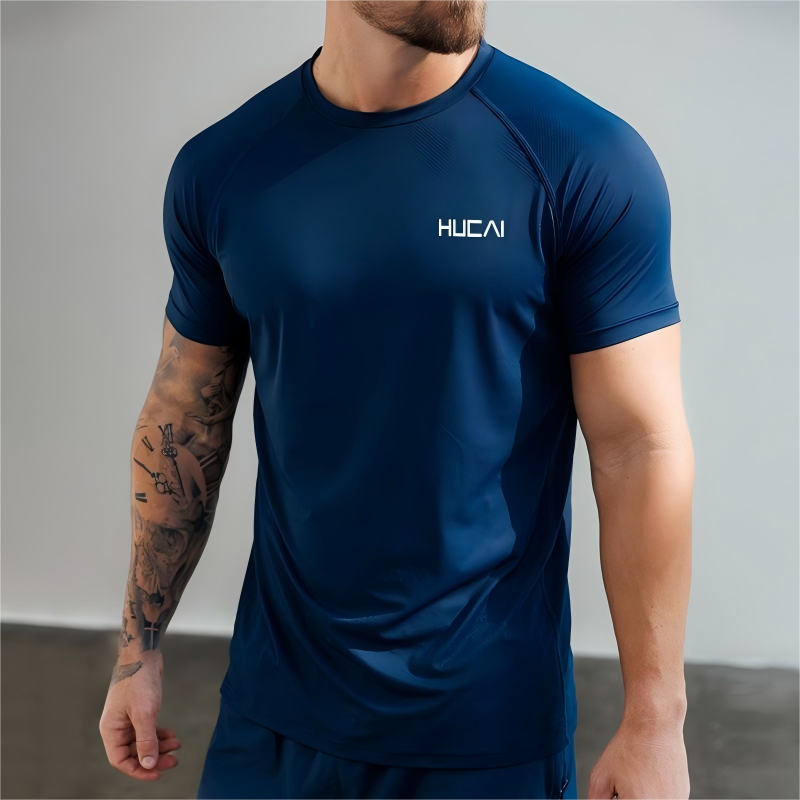
In spring and summer men's activewear development, fabric selection often plays a more decisive role than style. Particularly for high-intensity training, running or outdoor performance wear, cooling and breathable textured fabrics have become a primary focus among premium activewear brands. These fabrics not only affect body temperature control during movement but also impact moisture transfer, fit stability and long-term durability. For brands planning seasonal collections, they serve as a key differentiator in both product function and positioning.
Unlike traditional smooth fabrics, cooling textured materials use 3D structural knitting, thermal dispersion yarns and micro-ventilation surfaces, enabling better heat release and airflow. When brands aim to create professional training T-shirts rather than basic cotton/stretch models, this type of fabric provides a clear competitive advantage.
1. Cooling textured fabric vs. standard stretch materials
Traditional fabrics tend to emphasize comfort, while cooling textured fabrics prioritise both functionality and movement performance—especially in high-temperature environments.
| Comparison Point | Standard Stretch Fabric | Cooling Textured Fabric |
| Surface structure | Flat knit | 3D texture with micro ventilation |
| Heat dissipation | Average | Advanced, faster cooling |
| Sweat-wicking | Standard | Enhanced moisture transfer |
Weight | Possibly thicker | Lightweight |
Skin feel | Soft | Cool touch |
Ideal for | Basic sportswear | Performance training / outdoor wear |
2. Why it is highly effective for spring/summer men's T-shirts (paragraph + bullet points)
During spring and summer, athletes frequently train outdoors and sweat heavily. Standard fabrics can lead to heat accumulation and stickiness over time. Cooling textured fabrics avoid this by minimising skin contact and allowing continuous ventilation. They are especially suitable for brands developing performance-led collections.
Key benefits:
-Reduces skin-to-fabric pressure areas, preventing heat retention.
-Rapid moisture evaporation after high-intensity training.
-Suitable for running, HIIT, gym workouts and endurance sessions.
-Enables consistent fabric usage across multiple styles for cohesive collection development.
-Lifts product positioning from “comfortable apparel” to “functional performance wear”.
3. Fabric selection criteria – more than cooling effect
From a manufacturing perspective, performance fabric must not only cool effectively but also maintain its structure and shape after movement and washing. For high-end men's T-shirts, the following parameters are recommended:
✔ Weight range: 160–200 gsm.
✔ Elastic recovery: ≥95% after stretch.
✔ Steam shrinkage: <3%.
✔ Anti-pilling resistance: Grade ≥3.5.
✔ Colour fastness: Minimum Grade 3 on light colours.
For deep-colour or training T-shirts, anti-odour or sweat-discoloration protection is also recommended.
4. Common development issues & manufacturer solutions
When using textured cooling fabrics, brands often encounter technical challenges during sample testing. Lightweight structures may lead to shoulder or neckline deformation, and complex fabrics may shift during construction. Additionally, heat-based branding techniques must match the fabric's thermal tolerance to avoid distortion.
Recommendations:
-Add stabilizer tape at necklines and shoulder seams.
-Use digital cutting and edge reinforcement before stitching.
-For heat-transfer or bonding logos, adopt low-temperature application or switch to screen printing.
-Align laser perforation or ventilation zones based on movement lines (pattern engineer involvement required).
5. Development collaboration suggestions (manufacturer perspective)
For best efficiency, we recommend ODM with technical adaptation, instead of pure OEM execution—especially during spring/summer concept development.
Recommended collaboration models:
Rapid seasonal testing → use factory-recommended cooling textured fabric via ODM.
Existing design with need for performance upgrade → OEM pattern + ODM fabric integration.
One fabric across multiple style developments → improves cost efficiency and fabric MOQ control.
Cooling textured fabrics are not just about enhancing comfort; they define the technical level and seasonal competitiveness of men's sports T-shirts. From our experience working with performance-oriented brands, we recommend that during sample development, brands should:
✔ Integrate pattern development with fabric structural behaviour
✔ Test under high-heat and high-perspiration conditions
✔ Combine fit, ventilation mapping and construction durability in evaluation
✔ Use custom fabric library and proven structural templates for more accurate bulk execution
Spring/summer activewear development is no longer based solely on lightweight fabrics—it is guided by cooling efficiency, structural engineering and long-term shape retention. Choosing the right textured performance fabric is the most strategic step in designing a successful men's sports T-shirt series.
If you would like access to our cooling fabric swatch cards, proven pattern library or performance testing checklist for spring/summer sports T-shirts, feel free to contact our team. We offer customised development solutions tailored to your brand positioning.