Why “Invisible Design” Creates Visible Manufacturing Risk
- Share
- publisher
- 然
- Issue Time
- Jan 28,2026
Summary
Minimal aesthetics reduce visual noise—but they also remove tolerance. For a Sportswear Manufacturer, invisible design turns minor production variance into measurable brand risk.
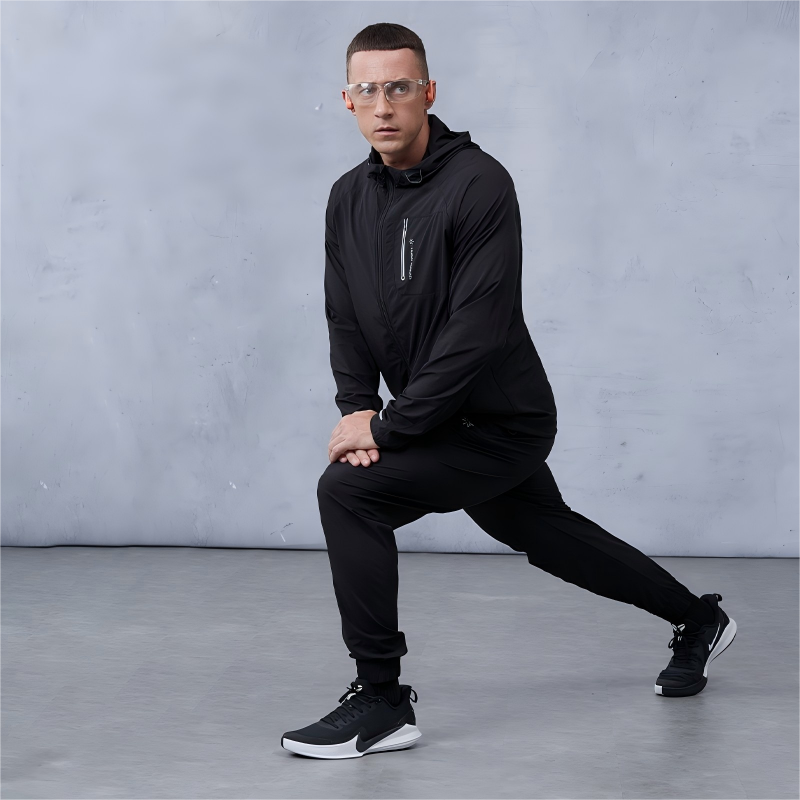
Invisible Design Eliminates Margin for Error
Minimal sportswear design is often misunderstood as a reduction in complexity. Fewer seams, fewer panels, fewer visual elements—on the surface, production appears simpler.
In reality, the opposite happens.
When decorative structure disappears, so does visual tolerance. Design can no longer absorb variation. The garment must rely entirely on material behavior, construction balance, and process stability to remain credible.
From a Sportswear Manufacturer’s perspective, invisible design does not simplify manufacturing—it exposes every weakness within it.
Why Minimalism Amplifies Manufacturing Variance
In expressive designs, inconsistency diffuses. In minimal designs, it concentrates.
A slight shift in fabric recovery alters drape.
A marginal change in seam tension changes body contact.
A minor batch deviation becomes perceptible through wear.
These differences may not register during sampling. They emerge only at scale, when repetition reveals variance the design can no longer disguise.
This is why minimal styles often show the highest perceived inconsistency across production runs—not because quality control failed, but because tolerance was removed by design itself.
The Hidden Cost of “Clean” Aesthetics at Scale
Minimal design transfers responsibility from visual execution to system reliability.
At this stage, success depends less on craftsmanship and more on discipline: how consistently materials behave, how predictably processes repeat, and how tightly deviation is controlled over time.
Many factories can execute a clean prototype. Far fewer can sustain that cleanliness once production scales and timelines compress.
Invisible design is treated as a high-risk production condition at HUCAI. Material stability, construction repeatability, and batch control are prioritized because minimal products reveal variation immediately—often through wear rather than sight.
Why Minimal Design Is Reshaping OEM Selection
As Western sportswear brands continue toward quieter visuals and longer wear expectations, the risk profile of manufacturing changes.
The critical question is no longer “Can this factory make it look clean?” It becomes “Can this factory keep it clean—repeatedly?”
Invisible design removes the safety net. Only disciplined manufacturing systems remain visible.
Welcome
Thank you for reading.
To learn how a Sportswear Manufacturer supports minimal design through repeatable, risk-controlled production,