Custom Men's Gym T-Shirts: How to Lock Fit Blocks Across Sizes
- Share
- publisher
- HUCAI activewear
- Issue Time
- Nov 6,2026
Summary
A B2B guide for men's activewear brands that need one gym T-shirt fit to hold across a full size run. Covers the anchor size, five control points, grade increments per point, tolerance bands, fabric-specific blocks, and a block version log so PPS and reorders stay aligned with the approved sample.

Custom men's gym T-shirt programs rarely fail because a brand chose the wrong fabric. They fail because the fit approved in one size was never turned into a controlled pattern block. For private label buyers, the gap between a sample that photographs well and a bulk order that fits the same in every size sits in the block and its grade rules.
HUCAI activewear develops men's gym T-shirt programs from a pattern library rather than a single sample, so the block, the increments and the measurement sheet are settled before the first fit sample is cut. That is the sequence used with custom men's activewear brands across the UK, the Nordics, Australia and the US.
Quick Answer
A fit block is the base pattern in one anchor size, plus the grade rules that move each measurement point, plus written definitions of how those points are measured. Locking it means confirming the anchor size, fixing five control points, setting a separate increment per point, separating blocks by fabric behaviour, and publishing one measurement sheet with tolerances.
Table of Contents
- Who This Article Is For
- What a Fit Block Is, and Why a Size Chart Cannot Replace It
- Choose the Anchor Size and Five Control Points
- Grade Rules That Keep the Silhouette, Not Just the Width
- One Block per Fabric Behaviour, Not per Colour
- Tolerance Bands and a Measurement Protocol You Can Repeat
- Locking the Block Through PPS, Version Log and Bulk
- Common Failure Modes and Where They Surface
- Decision Check Before Sampling
- Founder's Technical Insight (Jean Yuan)
- FAQ
- Final Takeaway
Who This Article Is For
- Primary reader: product development leads and technical designers moving from one-off samples to a graded size run.
- Secondary reader: sourcing managers comparing OEM and ODM suppliers, and private label buyers adding tees to a shorts-led range.
- Product stage: reference images or a worn sample exist, but no locked block or measurement sheet does.
- Problem being solved: every size fits slightly differently, gaps appear after washing, and reorders drift from the approved fit.
- Who may not need this article: brands buying stock sizes with no fit changes, or brands already holding a versioned block and tolerance sheet.
How This Guide Supports Your Development Decision
What you gain is a decision sequence: the points to confirm before a fit sample is cut, increment ranges that can be argued with data, a tolerance structure that survives pre-production sign-off, and a version log that makes a reorder behave like the first order.
What a Fit Block Is, and Why a Size Chart Cannot Replace It
A fit block is the base pattern in one anchor size with construction allowances built in: neckline shape and rib specification, shoulder slope, armhole curve, sleeve head, body width at chest and hem, and the stitch specification holding those lines. Grade rules then describe how each point moves as the size changes. The size chart is an output of that system, not the input.
Many early-stage programs run the sequence backwards. A sample is approved on a model, a chart is requested afterwards, and the numbers are reverse-engineered from one garment. That chart can look credible and still be unbuildable, because one garment cannot show whether the shoulder moved out or the armhole dropped.
Evidence used here (benchmark observation): public size charts from leading performance brands such as Ten Thousand, Gymshark, Castore and Represent show a consistent pattern for men's training tops. Chest circumference steps by roughly 2.5 to 3 cm per size, while body length steps by noticeably less. That asymmetry is decided at the pattern stage, so ask which size the block was developed in.
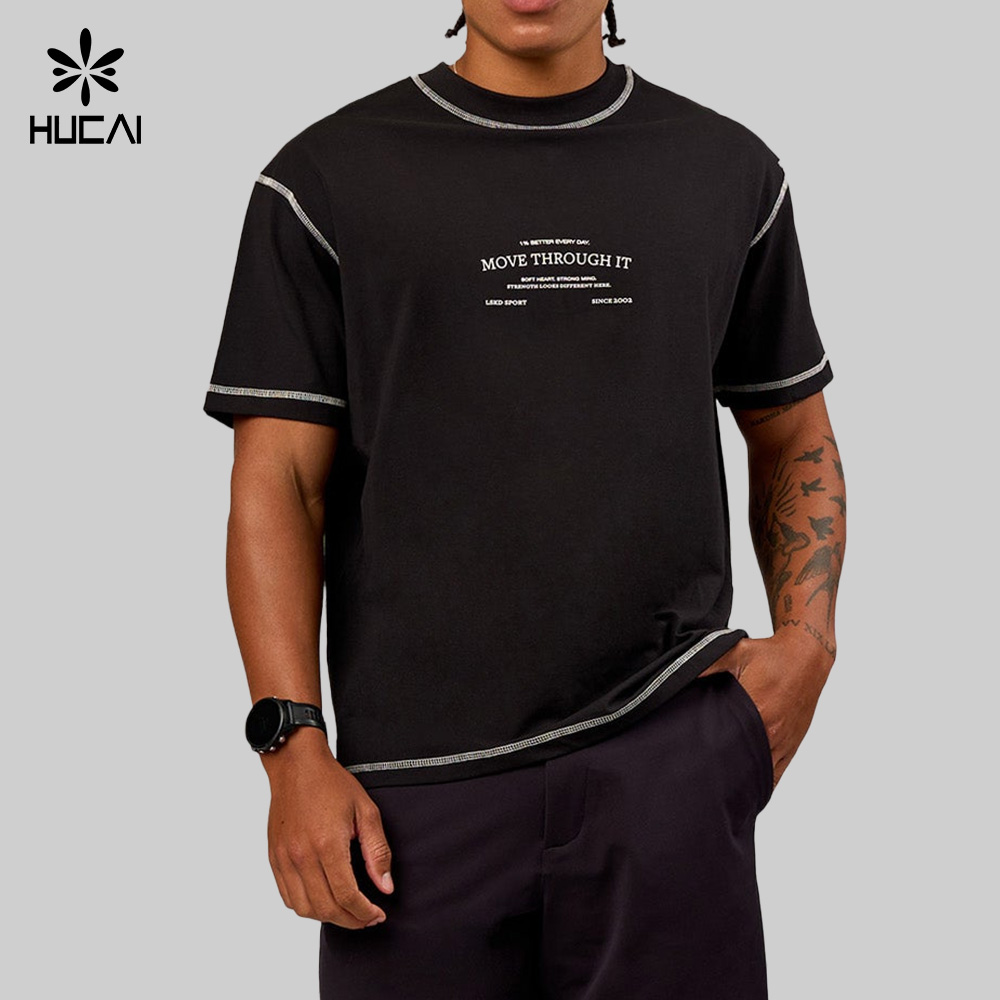
Contrast cover-stitching makes block lines visible: neckline shape, shoulder slope, sleeve angle, body width and hem length come from the pattern, and the stitching follows.
Choose the Anchor Size and Five Control Points
The anchor size is where fit intent is decided. For most men's gym T-shirt programs it is M, because that is where a brand can judge whether a relaxed body is genuinely relaxed rather than oversized on a smaller frame. Developing the block in M keeps the reference where most comments are made.
Five control points carry most of the fit: half chest measured flat below the armhole, body length from the high point of shoulder, shoulder width seam to seam, sleeve length, and half hem. Sleeve length needs a written definition, from the shoulder point on a set-in sleeve or the centre back neck on raglan and drop-shoulder styles. Neck width and armhole depth are secondary, but buyers notice them first.
Each point needs a definition, not just a number: which points on the garment, flat or on a form, with or without tension, rib relaxed or extended, and whether the garment is conditioned first. The pattern room at HUCAI activewear records the anchor size and control point set for every verified base block.
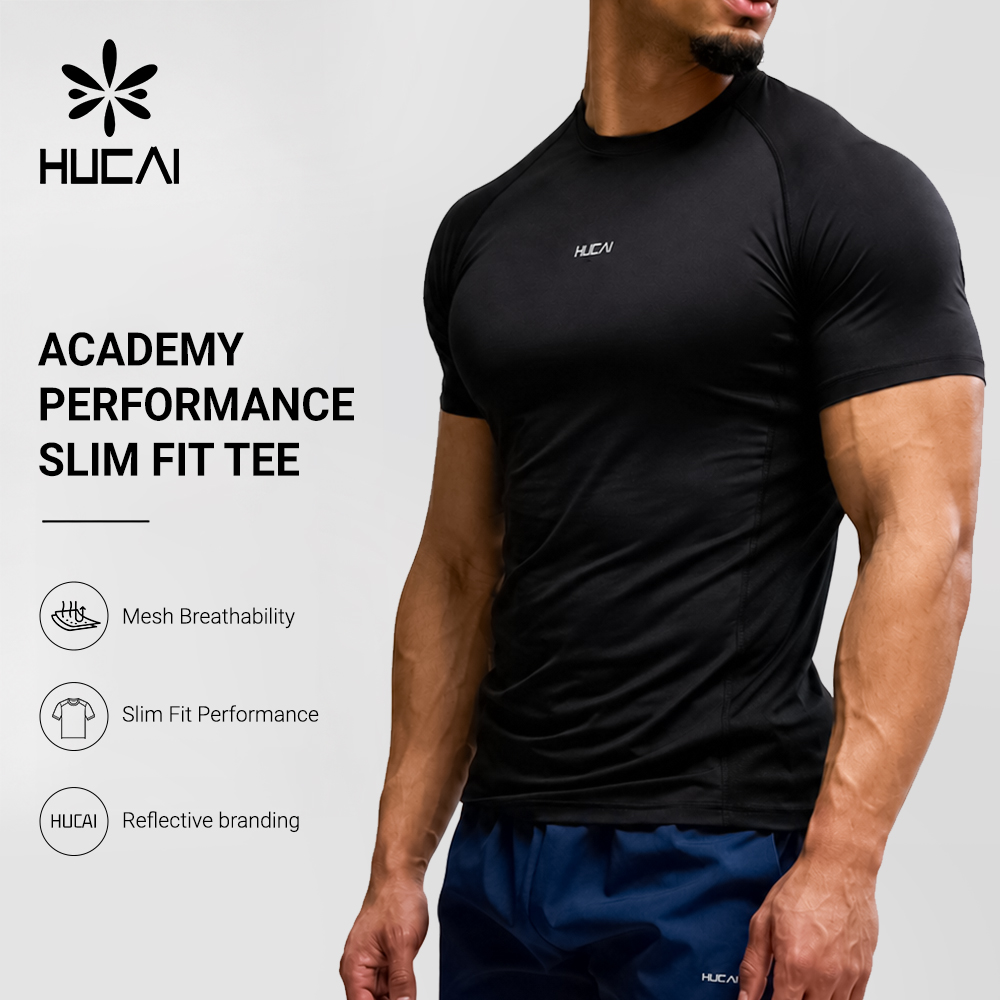
A slim-fit block reads as slim only while chest, waist and hem are graded as a family. Grade the chest and leave the hem, and the same block becomes a straight-cut tee by L.
Grade Rules That Keep the Silhouette, Not Just the Width
Grading is where a good block is usually lost. The common failure is applying the chest increment to every point, which is fast in a spreadsheet and wrong on a body: the tee grows wider and longer at the same rate, shoulders slide outward faster than the arm can follow, and the neckline opens at the largest sizes.
These ranges are starting points in men's knit T-shirt development, not fixed rules. Confirm them against the market, the fabric and the block, then write them into the grade rule set.
| Measurement point | Typical starting increment per size | What breaks when the chest increment is used instead |
|---|---|---|
| Half chest | 1.2 to 1.5 cm | Reference point; every other increment is judged against this one |
| Half hem | 1.0 to 1.5 cm | Hem wider than chest removes the taper and the tee hangs like a tunic |
| Body length from HPS | 1.0 to 2.0 cm | Length compounds with width; XXL ends up mid-thigh on shorter frames |
| Shoulder width | 0.6 to 1.0 cm | Shoulder seam travels down the arm and the sleeve head collapses |
| Sleeve length (set-in) | 0.5 to 0.8 cm | Sleeve reaches the elbow at XL and the style stops reading as a gym tee |
| Armhole depth | 0.5 to 0.8 cm | Armhole binds, the sleeve twists forward and the underarm seam rubs |
| Neck width | 0.4 to 0.6 cm | Neckline gapes; rib recovery is asked to fix a pattern problem |
Drop-shoulder and oversized styles need separate logic, because the shoulder point stops being a body landmark. Shoulder extension and sleeve length are graded together, with sleeve length taken from the centre back neck. Treating a dropped shoulder as a set-in shoulder is one of the few grading errors tolerance cannot correct.
Evidence used here (production practice): pattern makers and grading technicians report that armhole depth and shoulder slope drift first when a block is graded by formula, because both depend on chest width against arm circumference. Adjust armhole depth, shoulder slope and sleeve head as a set, then re-check the three-size fit.

An oversized block is not the anchor block widened. The dropped shoulder moves the sleeve length reference to the centre back neck, so shoulder extension and sleeve length grade as one decision.
One Block per Fabric Behaviour, Not per Colour
A block is valid only for the fabric behaviour it was developed on. A heavier cotton-rich single jersey and a lighter four-way stretch polyester-elastane cannot share a block, even when the style number and measurements are identical on paper. Elastane content, modulus, weight and recovery change the available ease and how the hem behaves after washing.
Evidence used here (industry testing logic): dimensional stability testing under ISO 6330 and AATCC 135 principles exists because knit garments do not return to their cut dimensions after washing. That forces one decision into writing: is the sheet before-wash or after-wash? If it is before wash and nobody records the after-wash figure, the size run shifts.
Stretch and growth matter for the same reason. Under ASTM D2594 test logic, a fabric can fit at rest and still grow through a session, so a tee that gains length at the hem is not the garment that was approved. One block per fabric family, not per colourway: the fabric library at HUCAI activewear groups qualities by behaviour, so substitutions are checked against the block they will be sewn on.
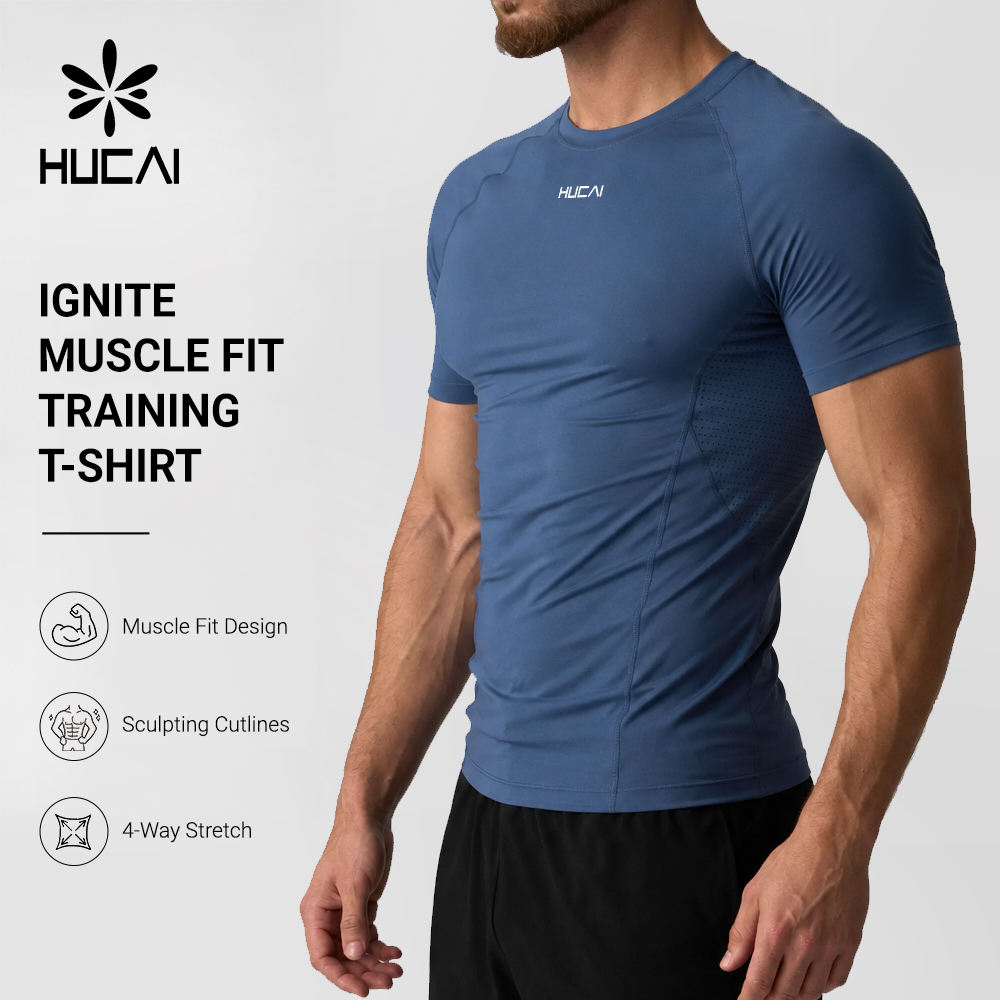
A high-elastane muscle-fit block: chest and waist are held by fabric recovery rather than seam shaping, so the grade rules and the wash specification belong to the fabric.
Tolerance Bands and a Measurement Protocol You Can Repeat
A grade rule without a tolerance is an opinion. Each point needs a permitted deviation reflecting how much it affects fit. Typical starting bands for men's knit gym T-shirts are around plus or minus 0.5 cm on chest and hem, 0.8 to 1.0 cm on body and sleeve length, and 0.3 cm on neck drop.
The protocol matters as much as the numbers. Take measurements on the same table, against the same definitions, with the same tension, after conditioning. Three pieces per size shows whether a deviation is a pattern problem or a sewing variance; before and after three washes shows whether the block survives its first month.
Sampling discipline pays here too. A fit review that only looks at M cannot validate a grade rule set: the anchor plus one end of the range shows whether increments hold, and three sizes on one table show whether the silhouette still reads as one product. In the sample room at HUCAI activewear, fit samples are measured against the sheet point by point.
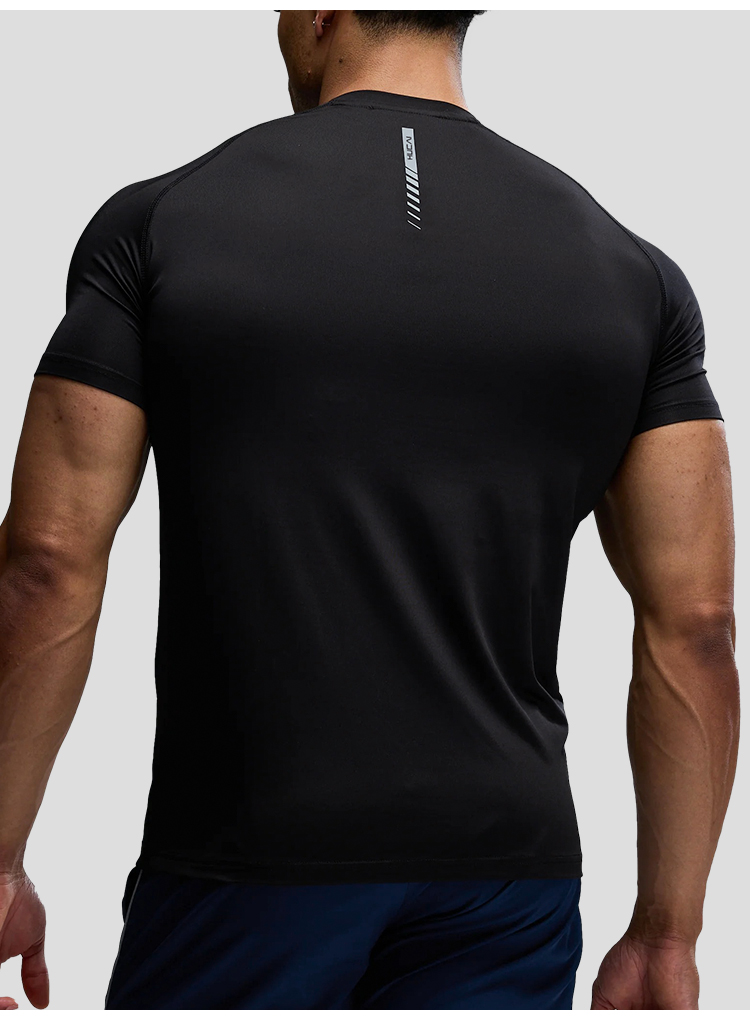
Back length, armhole depth and shoulder slope are usually the first three points to drift once a block is graded. They need their own lines on the sheet, not a note at the bottom.
Locking the Block Through PPS, Version Log and Bulk
Approval is not the end of the block; it is where the block stops being negotiable. The pre-production sample should be made with bulk fabric, trims and machines, then measured against the same sheet as the fit sample. If it passes on chest and length but sits two centimetres wider at the hem, the block was not locked; the sample was simply close.
A block version log is the cheapest control in the process and the one most often missing. It records the block identifier, anchor size, fabric family, grade rule version, and every change with date, affected point, old and new value, reason and approver. Without it, a reorder is rebuilt from an email thread.
In bulk, two checks protect the block: a first-article review per size at the start of cutting and sewing, and an AQL 2.5 inspection against the approved sheet. Order tracking in MES and ERP helps only when the block version is attached to the order. Evidence used here (community feedback): r/weightroom and r/fitness threads describe the customer side, where a reorder sits differently and a gap appears after washing.
Common Failure Modes and Where They Surface
The table converts the sections above into symptoms a brand can check against its own samples. The checkpoint column is where each problem is cheapest to catch.
| Symptom | Usual root cause | Checkpoint that catches it |
|---|---|---|
| Shoulder seam slides down the arm at L and XL | Shoulder width graded with the chest increment | Three-size fit review on one measurement table |
| Sleeve reaches the elbow on the largest size | Sleeve length graded without redefining the start point | Written point definition agreed before sampling |
| Neckline gapes only on larger sizes | Neck width graded at the chest rate; rib expected to compensate | Neck width and rib recovery recorded per size |
| Size run shifts after the first wash | Before-wash specification with no after-wash record | Wash test on three pieces per size before sign-off |
| Reorder feels different from the first order | No block version log; sample used as the reference | Block identifier printed on the measurement sheet |
| Pre-production sample passes, bulk drifts | Approval based on one size and one operator | First-article review per size at cutting and sewing |
Decision Check: Eight Points to Confirm Before a Fit Sample Is Cut
- Anchor size: which size the block is developed in, and who signed it off.
- Control point list: the five primary points plus the secondary points to be measured.
- Point definitions: flat or on form, tension, rib relaxed or extended, conditioning.
- Grade rule set: a stated increment per point, with the fabric family it was calibrated on.
- Fabric variants: how many blocks the range needs, based on quality and weight, not colour.
- Wash specification: before-wash or after-wash dimensions, and which cycle was used.
- Tolerance bands: a permitted deviation per point, agreed before sampling.
- Block ownership: which party holds the block file, grade rules and version log, and how changes are approved by HUCAI activewear and the brand together.
If five or more points are confirmed, the program can move into a structured sample request. If fewer are resolved, one round spent on the block costs less than two rounds correcting a grade.
Founder's Technical Insight: Jean Yuan on the Six Millimetres That Become a Size Gap
Jean Yuan, Founder of HUCAI activewear, frames grading as a physics decision rather than a spreadsheet one. "A block is a set of relationships. When a brand grades the chest by two and a half centimetres and leaves the armhole depth almost unchanged, the garment measures correctly on the table and stops working on the body, because the arm travels through an opening sized for a smaller chest. The correction is usually six to eight millimetres at the armhole and a small change at the shoulder slope. On the pattern table that is a pencil line; once fabric is cut for a full size run, those millimetres decide whether a size sells or comes back."
He applies the same reasoning to washing. A three percent length shrink sounds acceptable in a test report, but three percent on a small and on an extra large does not look the same, and the gap between adjacent sizes can disappear. Write the wash specification into the sheet and measure three pieces per size after washing; the technical team at HUCAI activewear asks for the fabric family before discussing increments.
FAQ
What is a fit block in men's gym T-shirt development?
The base pattern for one style in one anchor size, with construction allowances and the grade rules that move each point across sizes. The chart records the output; the block defines behaviour.
What is the MOQ for custom men's gym T-shirts?
MOQ is from 100 pcs/style. The practical number can move with fabric, colour count, size range, trims and logo method, since each adds a set-up step. Confirm the size breakdown with the quantity, because a wide range on a low quantity is what usually makes a program uneconomic.
How long does a sample round usually take?
Sample timing is usually about 10 to 15 days, depending on fabric availability, pattern work, logo method and revisions. Bulk production is often about 25 to 30 days after approval, subject to confirmed fabric, trims, quantity and scheduling.
Should the measurement sheet be before wash or after wash?
Either works if it is stated and applied consistently. After-wash is closer to what the customer experiences; before-wash is easier for the sewing floor to check in line. Many programs carry both columns on one sheet with the wash cycle at the top.
Why does the same style need more than one block?
Because fabric behaviour changes fit. A heavier cotton-rich jersey and a lighter four-way stretch quality hold chest, hem and armhole differently, and they shrink differently. One block per fabric family keeps the rules honest; colourways in the same quality share a block.
What usually causes repeated revisions in T-shirt sampling?
No written point definitions, so buyer and factory measure different things; a grade rule set applied to a fabric it was not calibrated on; and fit comments given against a single size. Each turns one revision into three, because the fix moves the problem to another size.
Final Takeaway
Locking a fit block across sizes is a sequence, not a document. Decide the anchor size, define the points in writing, give each point its own increment, separate blocks by fabric behaviour, publish tolerance bands, and protect the version with a log that survives reorders. Brands that do this once per fabric family stop re-approving the same T-shirt.
The commercial argument is simple: a block settled before sampling reduces revision rounds, protects the sizes that sell, and makes a second production run behave like the first.
Next Steps
If your measurements are confirmed: send the anchor size, control points and tolerance bands with your enquiry, and start with OEM men's sportswear support so the first sample is cut against your numbers.
If you have reference garments but no block: share the fit intent, fabric direction and size range, then review ODM men's sportswear development before the block is fixed.
If you are still comparing options: the men's gym T-shirt development page sets out construction and sampling steps, and the FAQ covers MOQ, timing and documentation questions raised before an inquiry.
For a range spanning several qualities, a short technical review of fabric family, anchor size and target size range is the fastest route. HUCAI activewear can then confirm which blocks exist in the pattern library and which need development.
About HUCAI activewear
- B2B men's activewear manufacturer supporting OEM, ODM and private label development for gym wear, training wear and running apparel.
- Pattern, fabric and trim libraries used to develop and version base blocks before sampling.
- Sample development and sample-to-bulk coordination, with measurement sheets carried from fit approval to pre-production sign-off.
- AQL 2.5 inspection and MES / ERP tracking used as process controls, not as outcome guarantees.
- MOQ from 100 pcs/style; sample timing usually about 10 to 15 days and bulk often about 25 to 30 days, subject to confirmed fabric, trims and order conditions.
Current certification information can be reviewed during supplier evaluation based on the project and documentation requirements.