How to Specify Men's Gym T-Shirt Necklines for Bulk Consistency
- Share
- publisher
- HUCAI activewear
- Issue Time
- Nov 12,2026
Summary
Men's gym T-shirt necklines drift between sample and bulk when the opening is described in words instead of numbers. This guide sets out six measured neckline fields, a rib band specification covering width, knit and cut ratio, three attachment constructions, an after-wash measurement protocol built on ISO 6330 and AATCC 135 logic, and the PPS and bulk gates that keep a crew neck stable across reorders.
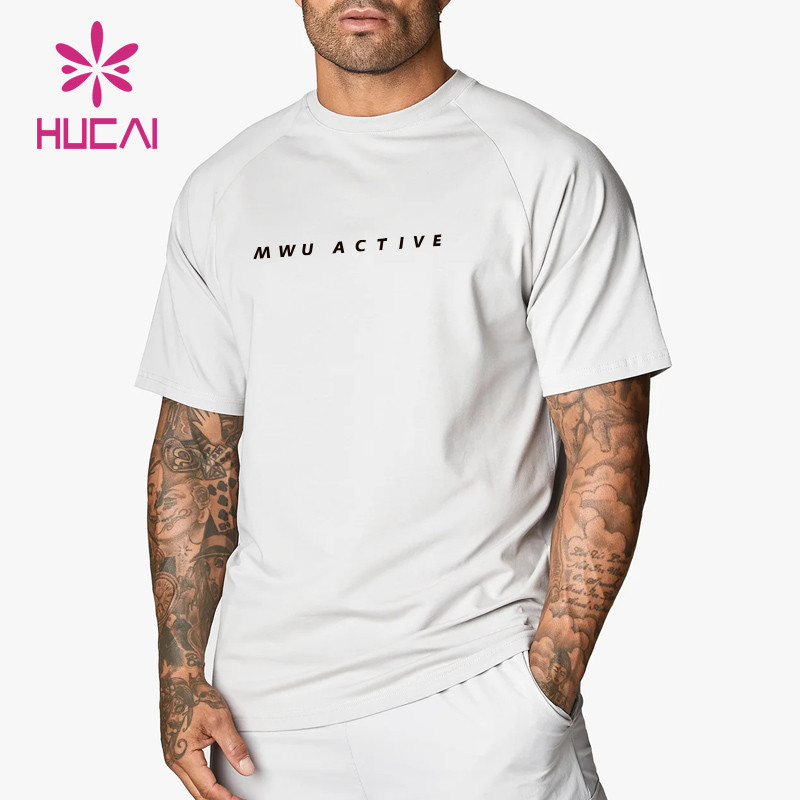
A crew neck looks like a minor detail until a bulk delivery arrives with a widened opening, a twisted band, or a front drop that sits two sizes from the approved sample. For brands buying through a gym T-shirt OEM manufacturer, the neckline is usually the first place where sample and bulk visibly disagree. This guide is written from the factory side: what to put in the tech pack, which numbers decide the opening, and how to hold the shape from PPS to reorder. HUCAI activewear develops men's gym T-shirts through OEM and private label programs, and this specification set is what we ask brands to confirm before a sample is cut.
Quick Answer
Specify six measured fields (front drop, back drop, opening width at the seam, finished band width, band recovery, neck-to-shoulder balance), attach the band with one named construction and stitch density, then approve it on measurements taken after three wash cycles rather than on the pressed sample. Set a tolerance per field, check three pieces per size at PPS, and re-approve whenever the rib lot or the body fabric changes.
Table of Contents
- Who This Article Is For
- Why a Neckline That Passed the Sample Still Fails in Bulk
- The Six Fields That Make a Neckline Specifiable
- Rib Band Specification: Width, Knit, Elastane and Cut Ratio
- Attachment Method and Seam Construction
- The After-Wash Measurement Protocol
- PPS Sign-Off, Bulk Gates and Change Control
- Decision Check
- Founder's Technical Insight (Jean Yuan)
- FAQ
- Final Takeaway
Who This Article Is For
- Primary reader: product developers and sourcing managers running a men's gym T-shirt program where the neckline moved between sample rounds.
- Secondary reader: private label buyers adding tees to a capsule and inheriting a neckline they did not specify.
- Product stage: tech pack in progress, or sample round one to two, before PPS approval and bulk release.
- Problem being solved: the neckline reads differently on the body, in the wash and in the carton, although the sample was signed off.
- Who may not need this article: brands printing on stock blanks, where the neckline is a fixed catalogue component.
What you gain from this article: a neckline field table to paste into a tech pack, a rib band checklist, a wash-and-measure protocol, a failure mode table that separates fabric causes from sewing causes, and the questions to ask before accepting a neckline sample.
Why a Neckline That Passed the Sample Still Fails in Bulk
Three variables move independently once production starts: the body fabric relaxes at a different rate than the sample roll, the rib band arrives from a lot with slightly different elasticity, and each operator pulls the band with different hand tension. Any one of them changes the finished opening.
Observations across leading performance activewear lines, including Gymshark, Castore and Ten Thousand, show band width and opening proportion matched deliberately to fabric weight. That is a product-design observation from public catalogues, not a market-trend claim, but it confirms the neckline is a specified component rather than a finishing afterthought.
Community threads on Reddit training forums describe collars that open after a few washes, or lift at the back neck once worn, usually on shirts bought for fit and never specified in numbers.
This article does not repeat the fit-block method in our guide to locking men's gym T-shirt fit blocks across sizes, which controls body width, length and grading. The neckline is a separate controlled feature with its own tolerance set, and it can drift while the body block stays correct. For fabric weight and fit family decisions upstream of this step, see men's gym T-shirt development; for shrinkage, colour and dye-lot control, see what affects men's gym T-shirt bulk consistency.
The Six Fields That Make a Neckline Specifiable
A description such as "crew neck, 2 cm rib" carries almost no production information: it does not say where the opening is measured, whether band width is finished or cut, or what the opening should do after washing. Six fields close that gap, all measurable on a flat garment with a steel tape.
| Field | How to measure it | What it controls |
|---|---|---|
| Front neck drop | High point of shoulder to front neck seam, garment flat and relaxed | How open the neckline reads on the body, and chest coverage |
| Back neck drop | High point of shoulder to back neck seam | Whether the back neck lifts or sits against the neck in training |
| Opening width at seam | Seam to seam across the widest point of the finished opening | The circumference the head passes through, and the visual proportion |
| Finished band width | Rib band only, measured perpendicular to the seam | Visual weight of the collar and its resistance to rolling |
| Band recovery | Extension and return after three wash cycles, recorded as a percentage | Whether the opening stays closed through repeat wear |
| Neck-to-shoulder balance | Neck seam to shoulder seam, measured on both sides | Symmetry, and whether the collar pulls to one side after washing |
The usual mistake is compressing depth and width into one "neck width" figure. Those numbers fail in opposite directions: an opening that is wide at the seam but shallow at the front reads tight and high, while a narrow opening with a deep front drop reads stretched. Separating them gives the pattern room two adjustments instead of one guess.
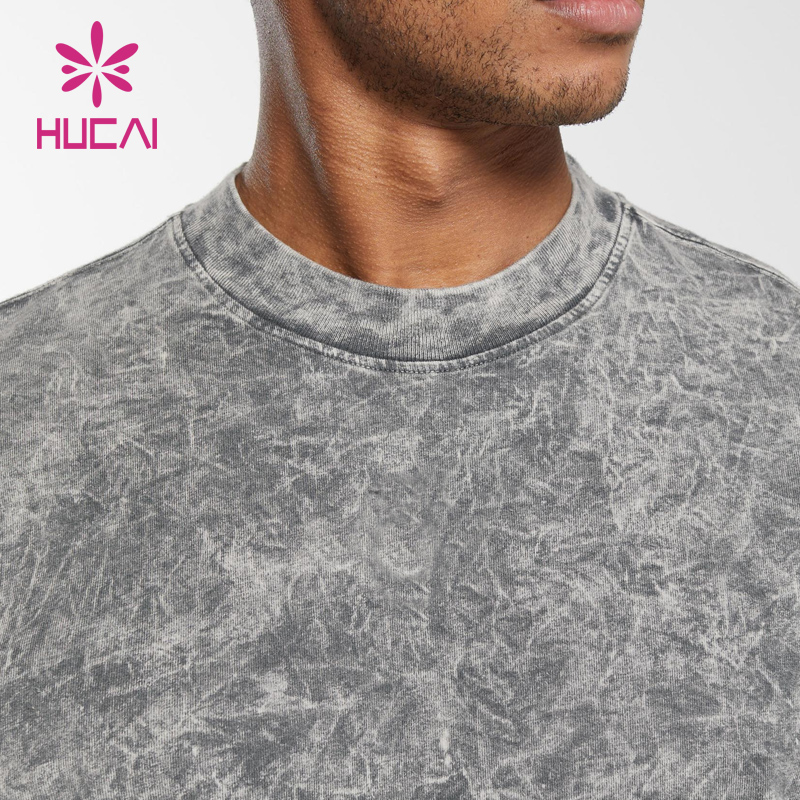
The photo shows the finished band width, the seam where the rib meets the body, and the grain of the washed jersey. Photographing the approved sample in this framing gives the bulk line a visual reference, not only a number in a spreadsheet.
Rib Band Specification: Width, Knit, Elastane and Cut Ratio
The rib band is a separate knitted component, not a strip cut from body fabric. Treating it as trim is a common cause of drift, because the band has its own elasticity, shrinkage and colour lot. A workable specification names five parameters and fixes at least four of them before sampling.
| Band parameter | Practical starting point | What moves if it drifts |
|---|---|---|
| Knit structure | 1x1 rib for lightweight training tees, 2x2 rib for heavier cotton tees | Density and spring-back; 2x2 reads thicker and carries a wider band |
| Finished band width | 18 to 22 mm for a standard crew, wider for oversized bodies | Visual proportion and resistance to rolling at the front curve |
| Elastane content | Held consistent between sample and bulk lots, recorded on the band card | Recovery after washing, and how quickly the opening relaxes |
| Cut length ratio | Band cut length set as a ratio to the finished opening, agreed on the sample | Too short puckers the seam, too long produces a wavy opening |
| Colour and lot | Band dyed to the body shade and approved against a lab dip | Visible shade break at the collar, most obvious on light colours |
Cut length ratio is the most useful lever in the specification, because it decides whether the band pulls the opening closed or lets it sit open. It cannot be copied from another style: a band that works on a 180 gsm jersey behaves differently on 240 gsm cotton, and a band specified for a slim fit looks under-built on an oversized body.

In the olive oversized tee above, the band is deliberately wider than on a standard training tee, because the body is heavier and the shoulder is dropped. A standard width would look thin against the body and would give the opening less structure to return to after washing.
Attachment Method and Seam Construction
Once the band is specified, the attaching method decides how much of that specification survives sewing. Three routes are common in men's gym T-shirt production, each with a different failure pattern.
- Rib collar set in with overlock and coverstitch: the standard crew neck route. It gives a clean internal finish and a stable opening when the seam allowance is controlled.
- Self-fabric band: matches the body shade exactly and suits heavier cotton tees, but recovers less than a knitted rib and needs a tighter cut ratio.
- Bonded or taped edge: a flat opening with no visible stitching. It depends on adhesive and heat control, and needs an explicit stretch test before bulk.
Stitch density belongs in the same sentence as the method. A lockstitch at roughly 10 to 12 stitches per inch on the band join, a coverstitch width that covers the allowance without stiffening the curve, and a seam allowance held to the millimetre are the settings that most often differ between a good sample and a bulk run. On high-elastane fabrics, needle size and point type matter too: a needle that cuts the knit leaves holes that open into a visible line after one wash.

The burgundy performance tee shows the neckline in relation to the shoulder seam: the band sits flush at the front curve, the raglan seam runs cleanly away from it, and the sleeve hem carries the same coverstitch logic. This is the area to photograph when a bulk lot reads softer at the collar than the approved piece.
The back neck deserves its own spec line. Back neck drop, tape width and the tape fold at the shoulder join decide whether the collar stands up or lies flat. Many training tees use a self-fabric or twill tape there to stabilise the seam and cover the overlock, and both functions should be stated so a substitute is not introduced silently at bulk.

The back view shows how much of neckline behaviour sits behind the head. If the back neck seam is pulled tight the front curve lifts; if it is left loose the collar rolls outward after washing. Measuring both drops on the same flat garment keeps the numbers tied to one sample.
The After-Wash Measurement Protocol
A neckline approved straight off the pressing table has not been tested. Relaxation and shrinkage move the opening, and the amount depends on blend, band and wash conditions. The protocol below follows standard test logic, so any lab or in-house team can repeat it.
- Wash cycles: three domestic cycles at 40 degrees Celsius following ISO 6330 procedure logic, one sample line dried and one tumble dried where the care claim allows.
- Dimensional change: record length and width change on AATCC 135 logic, so body shrinkage is known separately from neckline behaviour.
- Band recovery: measure extension and return on the band using ASTM D2594 stretch-and-recovery logic, and record the percentage rather than a pass or fail word.
- Seam integrity: check the band join for grin, needle damage and thread failure, with seam strength evaluated on ISO 13935-2 logic where a number is required.
- Conditioning: rest the washed garment flat for at least four hours, then measure all six fields with the same tape and the same operator as the pre-wash record.
Tolerances should be set per field, not per garment. A workable starting set is plus or minus 0.5 cm on opening width, plus or minus 0.3 cm on front and back drop, and plus or minus 1 mm on finished band width, with recovery expressed as a minimum percentage agreed on the approved sample. These are discussion points for the mill and pattern room, to be confirmed against the fabric and construction actually chosen.
Two rules make the protocol useful. Measure the same three pieces before and after washing so the change is attributable rather than averaged, and photograph each piece in the same framing, because a 4 mm band change is hard to argue from a number but obvious side by side. HUCAI activewear records these neckline readings per size in the sample file, so a reorder is compared against the original PPS numbers rather than memory.
PPS Sign-Off, Bulk Gates and Change Control
PPS is the last point where a neckline can change without cost. Sign it off on the six fields, the wash result, and three pieces per size taken from the line that will run the order, because three pieces show whether band tension is consistent between operators and whether the band lot is uniform.
The bulk gates are simple. Check the first 50 pieces in line against the PPS measurements, sample near mid-production, and inspect before shipment under AQL 2.5 with the neckline named as a defect category rather than folded into general workmanship. Where production runs on MES and ERP records, each check is a logged event tied to a date, line and lot, which is what makes a claim verifiable later.
| Failure mode | Most likely cause | Where it is caught |
|---|---|---|
| Wavy or rippled opening | Band cut too long, or attached without controlled tension | PPS visual, first 50 pieces in line |
| Opening grows after washing | Band elastane below the approved lot, or recovery not specified | After-wash measurement, three cycles |
| Band twists at the front curve | Band cut off grain, or seam allowance uneven around the curve | PPS visual on three pieces per size |
| Back neck lifts or gapes | Back neck drop too shallow, or tape too narrow to stabilise the seam | Fit review on body, back neck measurement |
| Needle holes along the seam | Needle size or point type unsuited to the knit, machine speed too high | In-line check after the first 50 pieces |
| Collar rolls outward | Band width too narrow for the body weight, or pressing set the curve open | PPS after wash, not before |
Change control is the part most programs skip. A new rib lot, a new body lot, a different attaching machine or a shift in thread supplier all justify re-measuring three pieces before the rest of the order runs. HUCAI activewear keeps neckline readings, the band card and the approved sample photograph in the same project record, so a repeat order starts from documented numbers rather than from a garment pulled off a shelf.

The grey pocket tee is the kind of image worth keeping in a QC file: seam lines clear enough to compare stitch density and allowance between approved sample and bulk piece.
Decision Check: Eight Points to Confirm Before a Neckline Sample Is Approved
Before requesting or approving neckline samples, confirm the following:
- Field set agreed: front drop, back drop, opening width, band width, band recovery and neck-to-shoulder balance are all named in the tech pack.
- Rib band specified as a component: knit structure, width, elastane content, cut ratio and colour lot sit on a band card, not in a sentence of prose.
- One construction named: rib collar, self-fabric band or bonded edge is stated, with stitch type and stitch density.
- Seam allowance fixed: a single allowance around the curve, with back neck tape width and fold method stated.
- Wash protocol attached: three cycles at the stated temperature, with the same three pieces measured before and after.
- Tolerances per field: each of the six fields carries its own tolerance rather than one garment-level pass or fail.
- PPS sampling defined: three pieces per size, taken from the production line, measured and photographed.
- Change triggers written down: rib lot, body lot, machine or thread change requires re-measurement before bulk continues.
If five or more are confirmed, the neckline is ready for a sample request with a measurable approval step. If fewer are resolved, the sample will still be produced, but approval will rest on opinion rather than numbers.
Founder's Technical Insight: Jean Yuan on Band Width Versus Recovery
Jean Yuan, Founder of HUCAI activewear, frames the neckline problem as a trade-off usually decided by hand feel rather than engineering. "Brands often choose a soft, thin rib because it feels comfortable in the sample room. After three washes that band has lost the spring that held the opening closed, and the customer reads it as a quality problem rather than a comfort choice. We ask two questions before approving a band: how wide is it finished, and how much does it return after washing. A 4 mm difference changes how the collar sits on a heavier body, and a band that recovers two percent less than the approved lot shows at the front curve within a few wears."
The attaching machine tension is set once and then trusted. "If a new operator joins the line, or the band lot changes, that setting needs recalibrating against a measured piece, not against a feeling. Teams that hold neckline consistency measure the first fifty pieces and write the result down. Teams that struggle approve a pressed sample and assume the line will repeat it."
FAQ
What should a tech pack include for a men's gym T-shirt neckline?
Six measured fields: front drop, back drop, opening width, finished band width, band recovery after washing, and neck-to-shoulder balance. Add the band specification, one attachment construction, stitch type and density, and a tolerance per field, so a sample can be approved against numbers.
Is a rib collar or a self-fabric band better for bulk production?
They solve different problems. A knitted rib recovers better and suits lightweight and mid-weight training tees. A self-fabric band matches the shade and suits heavier cotton, but recovers less and needs a tighter cut ratio. The body fabric weight should drive the choice.
How much does a crew neck opening usually move after washing?
It depends on blend, band and wash conditions, which is why a tolerance band is more useful than an average. Measure the same three pieces before and after three cycles at the stated temperature, then use that result as the approval number for the style.
Can a neckline be matched from reference images without a tech pack?
An image establishes direction: band width impression, opening proportion, construction type. It cannot establish drop, opening width or recovery, which follow the body block and the band lot. Convert the reference into the six fields, then confirm them on the first sample.
What causes a wavy or rippled neckline in bulk?
Most often the band was cut longer than the opening it had to close, or attached without controlled tension. Band cut off grain and an uneven allowance around the front curve look the same. The cause sits in cutting and attaching, so it usually appears across a whole lot.
How is a neckline checked during AQL 2.5 inspection?
As a named defect category with its own criteria: opening symmetry, band twist, puckering, needle damage and measurement against the approved sample. Folding it into general workmanship hides the pattern.
What is the MOQ for custom men's gym T-shirts?
MOQ is from 100 pcs/style. The final quantity can still be affected by fabric, colour, size range, trims and logo method, so it is confirmed with the quotation rather than assumed from the style alone.
How long does a neckline sample round take?
Sample timing is usually about 10 to 15 days and depends on fabric availability, pattern work, logo method, fit adjustment and revision rounds. Bulk timing is often about 25 to 30 days after sample approval, subject to fabric and trim readiness, quantity and scheduling.
Final Takeaway
A neckline holds in bulk when it is specified as a component rather than described as a style detail. Six fields give the pattern room something to adjust, a band card gives the mill something to match, one named construction gives the sewing floor something to repeat, and a wash protocol gives both sides the same number to approve. HUCAI activewear treats that sequence as part of sample development for men's gym T-shirts, because it turns a subjective argument about collar shape into a documented comparison between approved piece and bulk piece.
A small next step works better than a large one: fill the field table for your current style, then measure three pieces from your last delivery against it. If the numbers differ, the specification was incomplete rather than the production careless.
Next Steps
- Ready to develop a neckline: send the field table, the band card and any reference garment, and HUCAI activewear will confirm the construction route and sample priority before cutting.
- Need OEM support with confirmed specs: start from your tech pack and approved sample, and the neckline specification is checked against both before PPS.
- Need ODM development: if the neckline exists only as a reference image, review ODM men's sportswear development for the route from reference to measurable specification.
- Still comparing suppliers: use the eight-point decision check above as a question list, and compare answers rather than samples alone.
About HUCAI activewear
- B2B men's activewear manufacturer supporting OEM, ODM and private label development for gym wear brands
- Sample development, pattern support and fabric, trim, label and packaging customization within one development flow
- Quality checkpoints and AQL 2.5 inspection applied as process controls, with measurements kept against the approved sample
- MES and ERP follow-up for order and production tracking, so neckline checks stay linked to a lot, a line and a date
- MOQ from 100 pcs/style, confirmed together with fabric, colour, size range and logo method
Current certification information can be reviewed during supplier evaluation based on the project and documentation requirements.