Men's Performance Vest Development: Arm Mobility, Wind Protection, Insulation Zones and Packability
- Share
- publisher
- HUCAI activewear
- Issue Time
- Sep 17,2026
Summary
Many brands plan a vest as a jacket with the sleeves removed, then find the armhole twists, the back runs hot and the piece cannot be packed. This guide defines a men's performance vest as an independent layering tool: front shell and back ventilation zoning, armhole shape and arm mobility, light insulation zones, zipper, hem and pocket decisions, and packability. Includes a climate and capsule table, an eight-point decision check before sampling, and FAQ answers for OEM and ODM development.
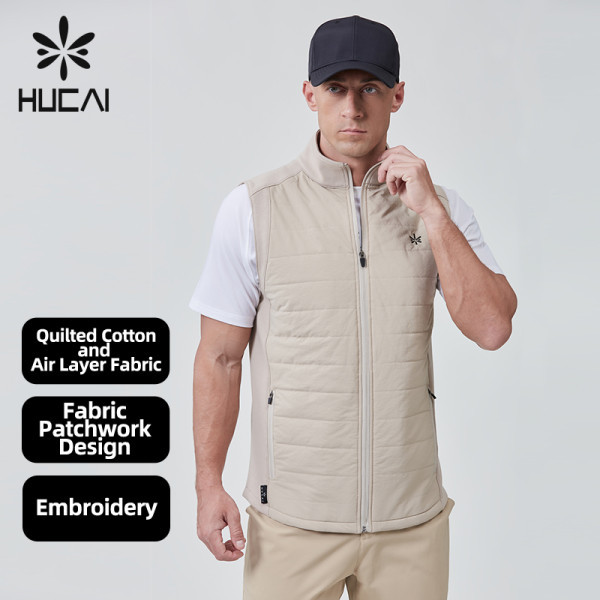
A performance vest is often planned as a jacket with the sleeves removed. That shortcut is where the problems start. For a private label activewear program, a men's performance vest has its own pattern logic: the armhole is a functional opening rather than a cut-off sleeve head, the front and back carry different jobs, and the packing structure changes how the whole piece is used. Brands developing custom men's activewear for running and hybrid training usually discover this after the first sample, when the armhole twists, the back overheats, or the vest will not compress small enough to be carried.
This guide, developed by HUCAI activewear with running and hybrid training brands, covers the development decisions that define a men's performance vest as an independent layering tool: front and back zoning, armhole shape and arm mobility, light insulation placement, zipper and hem control, pocket and packing logic, and how to match the piece to a climate and capsule plan.
Quick Answer
A men's performance vest should be developed as a layering tool, not as a sleeveless version of an existing jacket. The front panel is built around wind and light insulation protection for the core, while the back panel is built for ventilation and unrestricted arm swing. That split means the armhole needs its own shape, the front and back may need different fabric or construction, and the hem, zipper and pocket set have to be designed so the piece can be packed and carried. Start from the product role in the collection, then confirm armhole geometry, zoning and packing structure on the sample.
In This Guide
Who This Article Is For
Running and hybrid training brands
You already plan tops, shorts and a light layer, and you need a core-protection piece that does not duplicate the jacket in the line.
Growing brands
You have reference images and a clear idea of the season, but no confirmed construction for the armhole, zoning or packing.
Established and private label buyers
You have a spec direction and need the technical layers category to repeat predictably across colorways and seasons.
What You Get From This Guide
This is not a trend piece. It is a development reference you can use to brief a factory, write a tech pack, or challenge a sample you already received.
- A clear definition of the performance vest as a product role, so the piece stops competing with the jacket in your own line
- A zoning framework for front shell and back ventilation that you can confirm before the fabric order
- The armhole variables that decide whether the arms swing freely or the opening twists
- An insulation placement approach that adds warmth without turning the vest into a jacket
- A packing and pocket logic that makes the piece worth carrying
- An eight-point decision check to run before the first sample is cut
1. Why a Performance Vest Is Not a Sleeveless Jacket
A jacket is designed around coverage. The sleeve head, the armhole seam and the body panel work together to cover the arm. When the sleeves are removed, that system disappears, and the opening that remains is no longer a sleeve hole. It becomes a structural edge that has to hold shape, allow arm swing and finish cleanly on both sides.
This is the first development decision, and it is a product-role decision rather than a pattern detail. A vest sits in the collection for a specific reason: it protects the core while leaving the arms free. That reason defines what the piece has to do, and everything downstream follows from it.
A sleeveless jacket usually means
- The jacket pattern is shortened at the shoulder
- Front and back use the same shell fabric
- The opening is finished as a straight bound edge
- Insulation runs evenly across the whole body
- Packing is not part of the brief
A performance vest usually means
- The armhole is drawn as its own shaped opening
- The front is wind-focused, the back is ventilation-focused
- The opening is finished for movement and clean layering
- Insulation is placed in defined zones, not everywhere
- The piece is designed to be carried when not worn
For many men's running and hybrid training projects, the confusion is not about fashion direction. It is about product role. A brand that already sells a lightweight jacket may still need a vest, because the vest answers a different question: what does a runner wear when the arms should stay free but the chest still needs protection?
At HUCAI activewear, vest development usually starts by writing that sentence down before any pattern work begins. If the product role cannot be stated in one line, the armhole, zoning and insulation decisions have no reference point, and the sample round turns into an opinion exchange instead of a technical review.
What the vest replaces, and what it does not
A performance vest rarely replaces a jacket. It replaces the moment when a runner would otherwise be slightly over- or under-dressed: too cool to run in a single layer, too warm for a full jacket, or unwilling to carry bulk. That middle position is the whole reason the category exists, and it is also why packability is not an optional extra.
Once the role is clear, the development conversation becomes concrete. The team can decide which zone needs wind resistance, which zone needs airflow, how much insulation is justified, and how small the packed volume needs to be for the piece to earn its place in a kit.
2. Front Shell and Back Ventilation: Zoning the Two Halves
The defining construction feature of a performance vest is that the front and back do not have the same job. The front faces the wind and carries the insulation. The back faces the body's own heat output and needs to release it.
Zoning is the decision of where the front panel stops and the back panel starts, and which fabric or construction belongs on each side. It is confirmed early, because it drives the pattern, the fabric order and the cost of the piece.
| Zone | Primary job | Typical construction direction | Risk if ignored |
|---|---|---|---|
| Front chest and core | Wind protection, light insulation | Denser front shell, optional quilted or bonded zone | Rider feels cold and stops wearing the piece |
| Back panel | Ventilation, heat release | Lighter knit, mesh insert or perforated zone | The back overheats and the vest feels heavier than a jacket |
| Side body | Movement, stretch, fit continuity | Stretch or lighter panel connecting front and back | The body pulls when the arms swing |
| Shoulder and armhole edge | Structure, clean finish, mobility | Shaped opening with bound or bonded finish | The opening gapes, twists or rubs |
| Hem | Position control | Elastic, drawcord or bonded hem | The hem rides up during the run |
Two practical notes come up repeatedly in development. First, zoning must be decided before the fabric order, because a front shell and a back ventilation panel are often two different qualities with different minimums and different lead times. Second, the transition line between zones should follow a body movement line rather than a straight horizontal cut, so the piece does not pull when the arms swing.
3. Armhole Shape and Arm Mobility
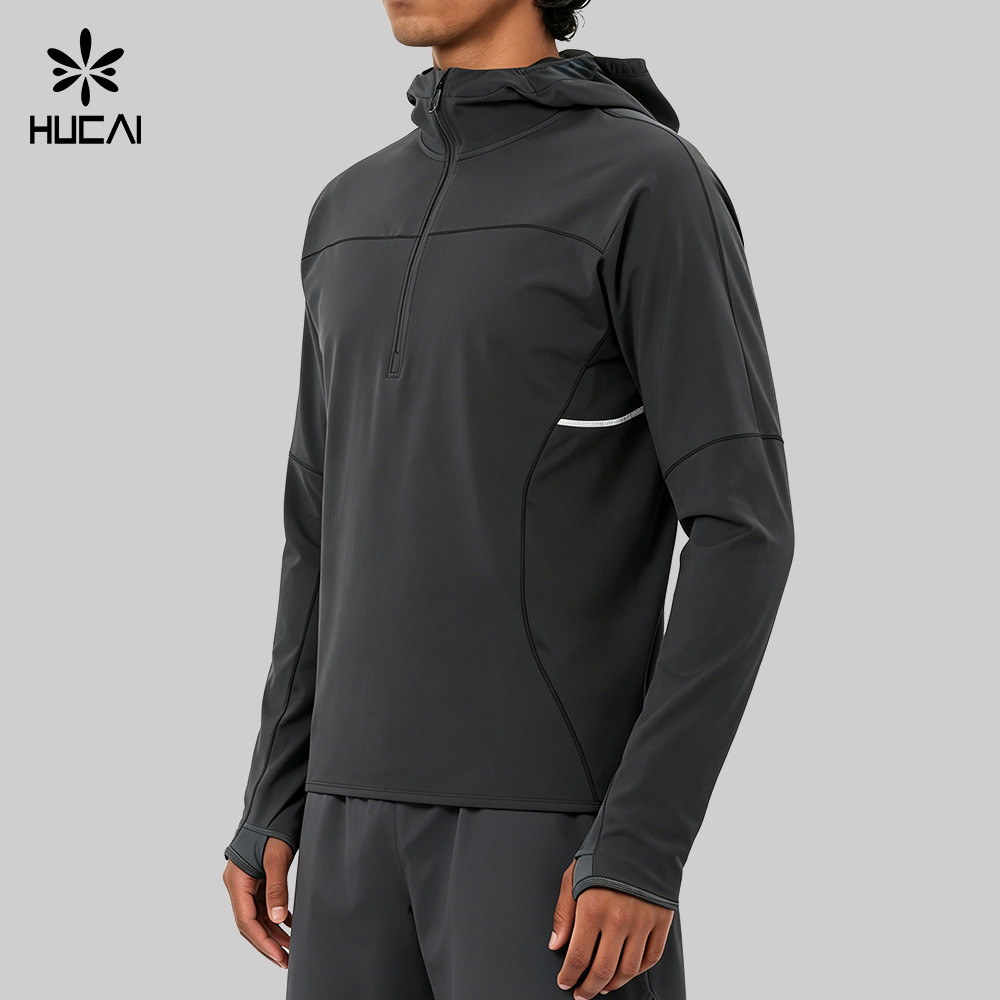
The armhole is where a vest is either comfortable or unusable. Because there is no sleeve to absorb movement, the opening has to be shaped so that the arm can swing forward, backward and across the body without the edge digging in, gaping open or pulling the front panel out of position.
The mistake is to derive the opening from the original jacket armhole. A jacket armhole is a seam allowance against a sleeve. A vest armhole is a finished edge on a moving body. They are not the same geometry.
The variables that decide arm mobility
- Opening depth - how far the edge drops below the shoulder line. Too shallow and the arm rubs; too deep and the front panel loses structure and the chest opens to the wind.
- Opening shape - a straight vertical line restricts swing. A slight curve that follows the shoulder gives the arm room without adding width.
- Front-to-back balance - the front edge and the back edge rarely need the same depth. The back usually sits higher to keep the shoulder blade area covered while the arm reaches forward.
- Edge finish - bound, bonded or folded. The finish adds stiffness, and that stiffness is felt directly against the arm.
- Shoulder width - a wider shoulder calms the opening but can look like a sleeveless jacket rather than a vest.
For custom men's activewear development, the useful test is a movement test rather than a flat measurement. The sample is worn, and the arm is taken through a full running swing, a forward reach and a cross-body reach. What matters is whether the edge stays flat against the body, whether the front panel lifts, and whether the opening returns to its position when the arm comes back down.
What usually goes wrong
The most common failure is an opening that is too narrow at the front and too high at the back. It looks acceptable on a hanger, then rubs on the first run and lets cold air straight into the chest as soon as the arms swing forward. The second most common failure is an opening that is deep enough for movement but not structured enough to hold the front panel, so the vest loses its silhouette and reads as a loose shell.
Both are pattern decisions, not fabric decisions, which is why the armhole is worth confirming on the first sample rather than the second.
4. Light Insulation Zones and Where They Belong
Insulation in a performance vest should be light and local. The moment insulation is spread evenly across the whole body, the piece stops behaving like a vest and starts behaving like a thin jacket, and the reason for carrying it disappears.
The placement question is simple: which part of the body needs protection when the arms are working and the body is producing heat? That is usually the chest, the upper back between the shoulder blades, and sometimes the lower back. Shoulders need wind resistance more than they need loft.
| Insulation approach | Where it is placed | Effect on the piece | When it suits a project |
|---|---|---|---|
| Front-only light insulation | Front panels only | Keeps the vest clearly a vest and controls cost | Running and hybrid programs with a warm back panel |
| Front plus upper back | Front and shoulder blade zone | Adds protection without closing off the lower back | Colder climates and stop-start training |
| Bonded lightweight wadding | Front panels, seamless look | Lower bulk, cleaner surface, fewer quilt lines | Brands wanting a technical, minimal surface |
| Quilted zones | Front, sometimes back yoke | More visual structure, more construction steps | Brands wanting a recognisable quilted identity |
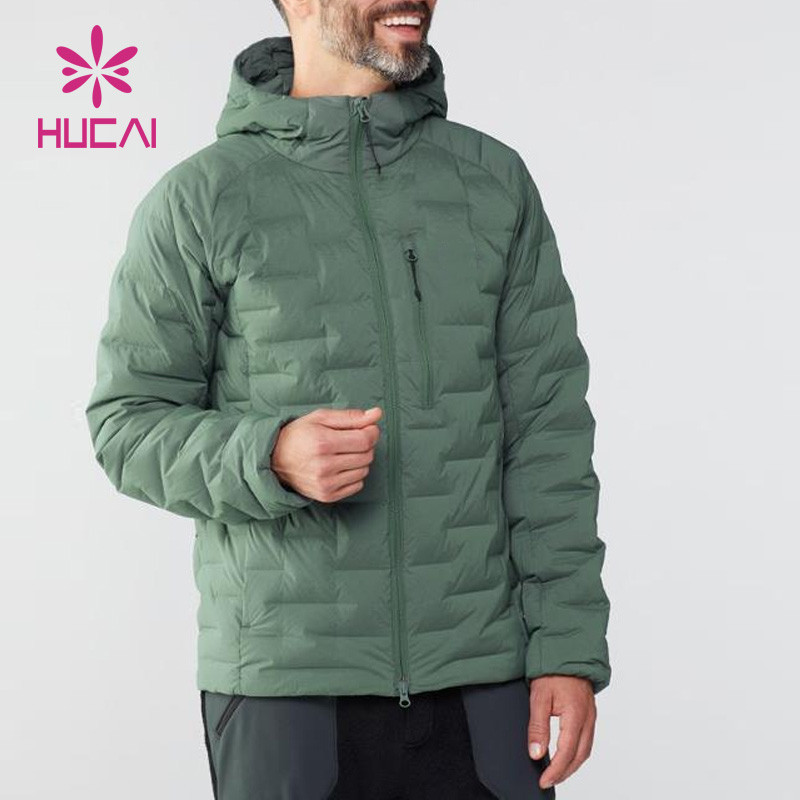
Two clarifications that prevent expensive sample rounds. First, the weight of the insulation matters more than the name of the fill; a very light wadding in the right zone outperforms a heavy wadding spread everywhere, because the runner is generating heat continuously. Second, insulation interacts with packability. More loft means more packed volume, so the insulation decision and the packing decision are the same conversation.
5. Zipper, Hem Control and Pocket Placement
Hardware is where a vest is quietly won or lost. Zipper length, zipper direction, hem control and pocket position all change how the piece behaves when the runner is moving.
Zipper
A full front zip gives the most venting control: closed for the cold start, partly open when the body warms up. A half zip reduces weight and cost and keeps the chest panel rigid, but it limits venting. The decision follows the climate the vest is designed for, not the other way around. Zipper guard and garage details matter on a vest because the zipper sits directly against a base layer with no sleeve to buffer it.
Hem control
The hem is the vest's position control. Without it, the front panel rides up during the run and the protected zone moves away from the chest. Options include a light elastic hem, an internal drawcord, or a bonded hem with a silicone grip. The choice is a balance between hold and comfort: too much grip and it digs in, too little and the piece lifts.
Pocket placement
- Chest pocket - holds a phone or gel close to the body so it does not swing.
- Back pocket - positioned above the hem so the load does not bounce against the lower back.
- Zip vs open - zip pockets stop contents moving; open pockets are lighter but only suit soft items.
- Pocket bag structure - a pocket that stretches with the panel will sag when loaded, so pocket bag construction is confirmed together with the panel fabric.
Pocket placement should be confirmed after the armhole and the hem, not before. Pockets shift the balance of the garment, and a pocket placed for the flat sample often sits in the wrong position once the arm swing and hem control are working.
6. Packability and Stow Logic
Packability is the feature that separates a vest from a jacket in daily use. If the piece cannot be reduced to a size that fits a pocket or waistband, the runner leaves it at home, and the vest stops earning its place in the collection.
Packability is not a single detail. It is the result of several decisions stacking in the same direction: lighter fabric, lighter zoning, lighter insulation, minimal hardware, and a construction that allows the garment to fold into itself.
Material weight
A lighter front shell and a light wadding reduce the folded volume more than any single design feature.
Hardware volume
Zipper length, cordlocks and bulky fastenings all add folded thickness. Each one should justify itself.
Stow structure
A chest pocket that the vest folds into, or a rear stuff zone, turns the piece into its own carry system.
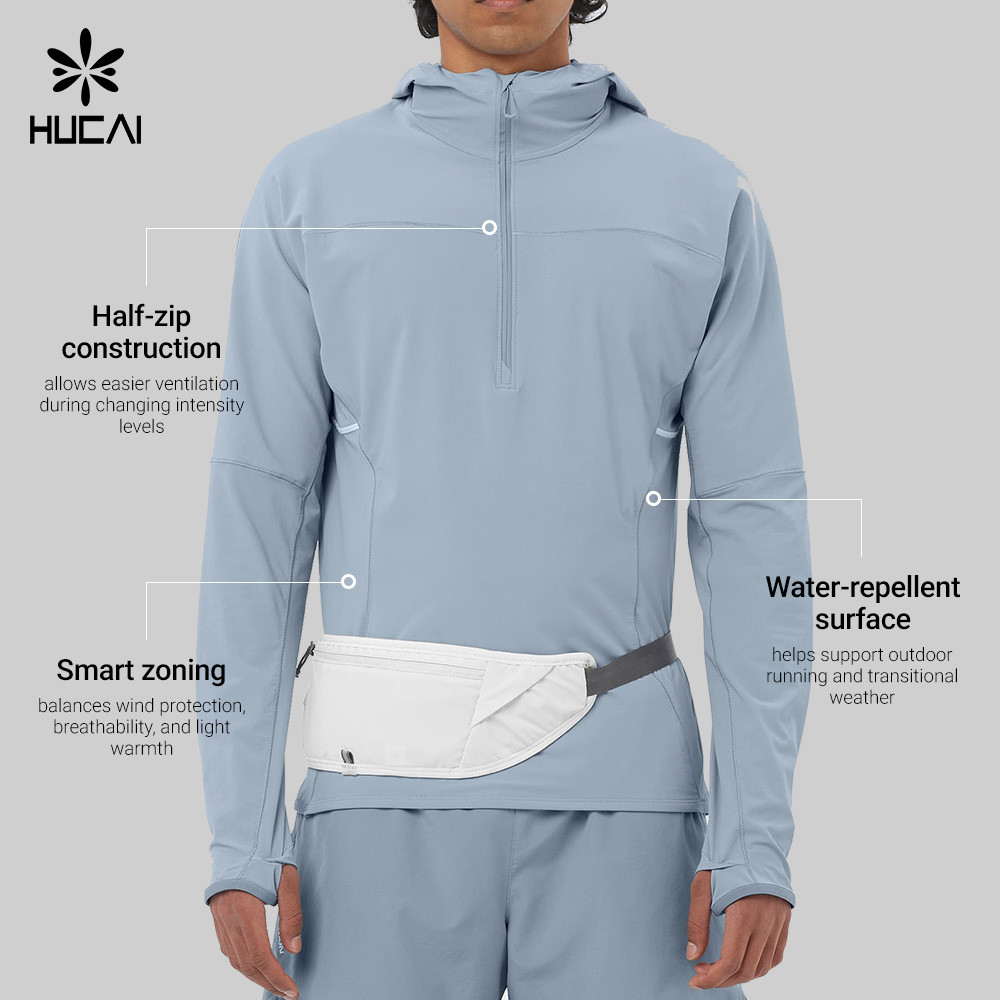
There is a trade-off to state plainly. Every gram removed from the fabric and the insulation reduces protection. The development task is not to make the lightest vest possible; it is to find the weight where the piece still does its job and can still be carried. For many projects that point is reached with a lighter front shell and a more open back panel, rather than by stripping insulation unevenly.
7. Matching the Vest to Climate and Capsule
A performance vest is not one product. It is a product family, and the version a brand needs depends on the climate it sells into and the role the piece is meant to play inside a capsule. Developing one vest for every market is the fastest way to end up with a piece that is slightly wrong everywhere.
Two versions cover most running and hybrid training ranges: a transitional version for cool starts and shoulder seasons, and a colder-weather version for genuine winter training. They differ in fabric weight, insulation approach, back ventilation and hardware.
| Variable | Transitional vest | Colder-weather vest |
|---|---|---|
| Product role | Cool start, warm finish, easy to remove and carry | Core protection through the whole session |
| Front shell | Light wind-resistant shell | Denser shell with stronger wind resistance |
| Back panel | Highly open, mesh or perforated | Ventilated but with a covered upper back |
| Insulation | Minimal, front only, or none | Light front insulation plus upper back zone |
| Zipper | Half zip or light full zip | Full zip with guard and garage |
| Hem | Light elastic, minimal hold | Drawcord or gripped hem for position control |
| Packing | Folds into its own pocket or a small stuff zone | Compact fold, larger packed volume accepted |
| Sampling priority | First piece to confirm the armhole and zoning | Second piece, developed from the confirmed block |
How the vest fits a capsule
Inside a run or train capsule, the vest sits between the base layer and the shell. It should share the base layer's fabric family and color story so it layers without bulk or visual conflict, and it should not duplicate the positioning of a lightweight jacket already in the line. If the jacket is the wind-and-rain piece, the vest is the core-protection piece; if the jacket is already the midlayer, the vest is likely redundant and the range needs a different decision.
This is where product-role clarity pays off commercially. A vest that has been given its own role can be planned as a repeatable carryover, developed once, and repeated across colorways, rather than being rebuilt every season because nobody is sure what it is for.
8. Decision Check Before Sampling
Run through these eight points before the first sample is cut. Each one has a defined answer, and each unanswered point is a revision round waiting to happen.
- Is the vest's product role written in one line, and does it avoid duplicating another piece in the line?
- Is the front zone defined by fabric and function, separately from the back zone?
- Is the back ventilation method chosen: lighter knit, mesh insert or perforation?
- Is the armhole drawn as its own shaped opening rather than derived from the jacket armhole?
- Has the opening depth been balanced front to back, and has the shoulder width been confirmed?
- Is the insulation limited to defined zones, and has its weight been confirmed against packability?
- Are the zipper length, hem control and pocket positions confirmed as one set of decisions?
- Is the packed volume target stated, and does the stow structure support it?
Manufacturer Insight: Sample-to-Bulk Coordination on Vest Details

Vest development has an unusually high number of small construction decisions relative to the size of the garment. Armhole shape, zoning transition, insulation placement, hem control and pocket position all sit close together, and a change in one usually moves another.
At HUCAI activewear, the practical way to keep those decisions stable is to record them in the same place as the sample. Zoning lines, armhole dimensions, insulation zone boundaries, hem specification and pocket positions are written into the construction record when the sample is approved, so the bulk team works from the approved sample rather than from a description of it.
That record is then tracked through development follow-up. AQL 2.5 quality inspection and pre-production review are used as checkpoints inside that flow rather than as a final gate, and MES / ERP production tracking keeps the sample, bulk and quality stages visible to the same project team. The point is not technology for its own sake; it is fewer avoidable misunderstandings between the approved sample and the bulk run, which is where vest details are most likely to drift.
Where OEM and ODM differ on this category is mostly about who owns the decisions. Brands arriving with a confirmed spec direction and a target packed volume are usually working in an OEM flow, with the factory executing against the agreed construction. Brands arriving with reference images and a season plan are usually working in an ODM flow, where zoning, armhole geometry and insulation placement are developed together before the first sample is cut. Both paths end in the same place: a construction record that bulk production can follow.
Common failure pattern
A recurring pattern in this category is the vest that was developed from a jacket pattern, sampled once, and approved visually. The sample photographs well, so the piece moves forward. Then the feedback arrives in use: the armhole rubs, the back runs hot, the chest panel opens in the wind, and the piece is too bulky to carry. Because the product role was never defined, there is no way to judge which of these is a defect and which is a design choice, and the second sample round starts from the beginning instead of from a target.
What reduces revision rounds
- Define the product role before the pattern, so there is a reference to test against.
- Confirm zoning before the fabric order, not after the first sample.
- Test the armhole through a movement range rather than on a flat table.
- Place insulation in named zones and record the zone boundaries.
- State a packed volume target so packability is measurable.
- Confirm zipper, hem and pockets as one hardware set.
FAQ
What is the MOQ for custom men's performance vest development?
For men's activewear development, MOQ from 100 pcs / style is the usual starting point. The final figure still depends on the fabric, the color, the size range, the customization level, the trims, the logo method and how the order is structured. A vest with a bonded front and a mesh back panel can carry different minimums from a simple single-fabric piece, because the component qualities have their own minimum order quantities.
Do we need a tech pack before starting OEM or ODM development on a vest?
No, but the more you bring, the faster the first sample becomes useful. A completed tech pack usually means OEM execution against a confirmed direction. Reference images, a season plan and a target climate usually mean ODM development, where zoning, armhole geometry and insulation placement are developed with the factory. What is worth confirming either way is the product role and the packed volume target, because both change the pattern decisions.
How long does a sample round usually take for a men's performance vest?
Sample timing depends on fabric availability, pattern work, logo method, fit adjustment and the number of revision rounds. A vest with a symmetrical two-fabric construction and confirmed zoning moves faster than a piece where the transition line and insulation zones are still being decided. Fixing the zoning and the armhole before cutting the sample reduces revisions, which is usually the largest saving on the timeline.
Can you work from reference images if we do not have a technical drawing?
Yes. Reference images are a normal starting point for ODM development. What makes them work is pairing each reference with a stated intent: this image shows the armhole shape we want, this one shows the back ventilation, this one shows the packed size. Images alone show a look; the intent behind them is what converts into a pattern.
Why does the armhole on our current vest twist or rub?
The usual cause is that the opening was derived from a jacket armhole rather than drawn as its own shaped edge. A sleeve seam is designed to be joined to a sleeve; it has no reason to sit flat against the body on its own. Opening depth, front-to-back balance, edge finish and shoulder width all need to be set for movement, and the check should be a movement test on a worn sample rather than a flat measurement.
Should a performance vest have insulation in the back panel?
Usually the back should ventilate more than the front, because the back carries the runner's own heat output. Light insulation across the upper back can help in genuinely cold conditions when the piece is worn over a base layer, but insulating the full back panel tends to make the vest run hot and pushes the piece toward behaving like a thin jacket. The front-to-back imbalance is the feature, not a compromise.
Is a half zip or a full zip better for a running vest?
It depends on the climate the piece is built for. A full zip gives the widest venting range and suits colder conditions where the runner wants to open the piece once warmed up. A half zip is lighter, uses less hardware and keeps the chest panel more rigid, which suits transitional versions. The zipper decision should follow the product role, and it should be confirmed together with the hem control and pocket set rather than on its own.
What should be confirmed before MOQ or quotation discussion?
Bring the product role, the target climate, the front and back construction direction, the armhole approach, the insulation zones and the packed volume target. With those confirmed, a quotation can be built against a real construction instead of a range of assumptions, and MOQ implications from the fabric and trim choices can be explained clearly instead of appearing later as a surprise.
Final Takeaway
A men's performance vest is decided by its product role, not by its pattern heritage. Define what the vest is for in the collection, separate the front protection zone from the back ventilation zone, draw the armhole as its own shaped opening, keep insulation light and local, and treat packability as a design requirement rather than a bonus.
Get those decisions confirmed on the sample and recorded in the construction file, and the piece becomes a repeatable carryover in the range. Skip them and the vest becomes the garment that photographs well and never earns its place in the kit.
Next Step
Ready to develop a performance vest line? Share your tech pack, reference images or target product direction and the zoning, armhole and packing decisions can be reviewed against a real construction. Send your vest development brief.
Have confirmed specs? Start with OEM sample-to-bulk support so the approved armhole and zoning are carried into bulk through one construction record. Review the technical layer range.
Still comparing options? Look at the existing sleeveless and layering categories before finalising the capsule. Sleeveless and tank styles and base and long sleeve layers show how the vest should sit between them.
Trust Notes
HUCAI activewear supports OEM, ODM and private label men's activewear development, including sample development, pattern and sample maker support, fabric and trim customization, logo, woven label, care label, hangtag and packaging customization, and sample-to-bulk coordination.
Development and production are followed through the same project flow, with quality checkpoints, AQL 2.5 quality inspection and MES / ERP production tracking used to keep sample and bulk aligned. Every construction detail discussed in this article - zoning, armhole, insulation zones, hardware and packing - is confirmed on the sample before bulk planning starts.