Men's Running Trousers: How to Develop a More Technical Alternative to Standard Joggers
- Share
- publisher
- HUCAI activewear
- Issue Time
- Oct 26,2026
Summary
Most men's running trousers are joggers with a new label. This guide sets out the four decisions that make a trouser technical - product role, fabric base, articulated pattern and secure storage - plus the seam, test and sample validation steps that cut revision rounds before bulk.
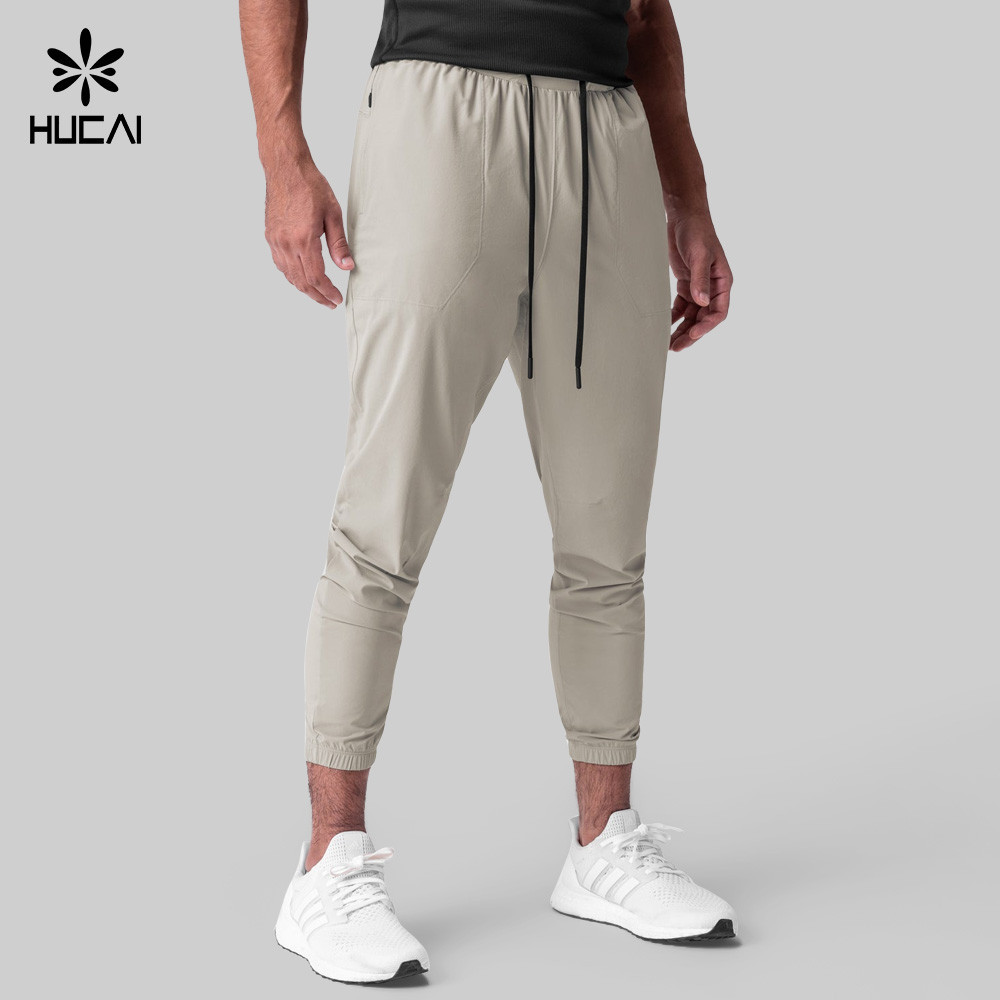
Most men's running trousers sold today are joggers with a new label. The block is a gym jogger, the base fabric is a brushed fleece in the 280 to 340 gsm range, and the only running-specific change is a reflective mark near the calf. For a brand selling into running communities, that shortcut becomes visible in the first kilometre: the garment holds sweat, the elastic cuff catches the shoe collar, and a phone sits in an open slash pocket that swings with every stride.
This guide is written from the product development side of that problem. It explains how a men's activewear manufacturer such as HUCAI activewear structures a running trouser program - product role, fabric base, pattern articulation, storage, seam construction and sample validation - so the finished garment is a technical product rather than a jogger with running marketing attached to it.
Every judgement below is tied to a stated source: public product analysis of current premium running ranges, feedback from running communities, published textile test logic, and pattern-room experience inside bulk production. Engineering opinions are labelled as such.
Quick Answer. A technical running trouser is not defined by fabric alone. It is defined by four decisions taken before the first sample is cut: a product role that separates it from the warm-up jogger, a fabric base matched to the pace and climate it will be worn in, a pattern with an articulated knee and enough seat depth for a full stride, and a storage system that keeps a phone still. Brands that lock those four decisions before choosing a swatch usually need fewer sample rounds. Brands that start from a fabric they liked at a trade show typically revise the block two or three times.
Short version: use a woven four-way stretch shell for tempo work and wet weather, keep a knit jogger for warm-up and recovery, and treat a compression tight as a separate layer rather than a substitute for trousers.
Who this article is for. Product developers, sourcing managers and founders building a men's running or training range who already sell shorts or T-shirts and now need a legwear option that can carry a higher price and a clearer technical story. It assumes you have reference images or a tech pack, not necessarily a finished specification. If your range is still at category-planning stage, read the role section first and skip the pattern detail until you have booked a fit session.
What you can take from this page. A role map for choosing between a jogger, a woven running trouser and a tight; a fabric comparison naming the tests worth asking for; the pattern points that cause most sample revisions; and a validation sequence for your own sample room. Nothing here replaces a fit session on a live model, and the aim is to make trade-offs visible before they become bulk problems.
Why a standard jogger fails at running pace
Public product analysis across current premium running ranges - Tracksmith, Satisfy, Ten Thousand and Castore among them - shows a consistent split. Their warm-up and recovery pieces are knit, usually a french terry or interlock with a soft hand feel. Their running-specific legwear is either a light woven stretch shell with a durable water-repellent finish, or a high-stretch knit built close to the leg. Almost none of them sell a brushed fleece jogger as race or tempo equipment. That is a market signal about product role, not a stylistic preference.
Feedback in running communities points at the same failure modes from the wearer side. Threads on r/running and r/AdvancedRunning repeatedly describe joggers as too warm once pace rises, heavy and slow to dry after rain, and prone to a swinging phone in an unsecured pocket. Runners also report abrasion at the inner thigh where a bulky seam or a thick panel edge sits against skin for 90 minutes. These are construction complaints, which means they are solvable at the pattern and seam stage rather than by changing the print.
The mechanical reasons are straightforward. A brushed fleece traps a layer of warm air, which is desirable during a warm-up and a liability at threshold pace. A knit jogger also stretches in every direction, so a loaded pocket drags the whole panel rather than staying anchored. And a standard jogger cuff is an elastic band sized for streetwear, not for the repeated flex of an ankle in a running shoe.
Three product roles: jogger, running trouser, compression tight
Before fabric selection, decide which of three roles the style is filling. The table below is the working map used in development reviews, because most range confusion comes from asking one garment to cover two roles.
| Role | Typical base | Best use | Main development risk |
|---|---|---|---|
| Knit jogger | French terry or interlock, roughly 260-340 gsm | Warm-up, recovery, travel, cold easy runs | Moisture retention, wind permeability, unsecured pocket |
| Woven running trouser | Nylon or polyester elastane woven, roughly 130-190 gsm, DWR finish | Tempo, commuting runs, wet or windy conditions | Seat and knee restriction if the block is not articulated; fabric noise |
| Compression tight | Knit nylon elastane, four-way stretch | Race pace, layering under shorts or trousers | Waistband pressure, seam chafe, opacity when stretched |
Two practical notes from development reviews. First, a woven running trouser with a knit waistband and knit gusset often satisfies both comfort and weather requirements, but the mixed-material seam becomes a chafe risk that must be placed deliberately. Second, a compression tight is a layer, not a trouser replacement: brands that position it as the only legwear for winter running usually see complaints about warmth at the first cold snap.

Once the role is fixed, the rest of the specification follows a sequence: fabric base, then pattern, then trims, then validation. Jumping to trims first - a zip here, a reflective print there - is the most common reason a running trouser ends up costing more than it performs.
Fabric and finish decisions that change the garment
Knit bases: warmth versus drying speed
In knit constructions, french terry and interlock behave differently in ways that matter at pace. Terry holds more air in its loop structure, so it feels warmer at low effort and holds more water after rain or a long effort. Interlock is smoother and denser against the skin, dries faster, and usually prints and bonds more cleanly. For a warm-up jogger, terry is a reasonable choice. For anything a runner will wear continuously above easy pace, the same terry becomes a thermal penalty.
Experienced sportswear pattern makers also point out that knit trousers hide fit problems during sampling because the fabric accommodates the body. That forgiveness disappears in bulk if the elastane percentage or the heat-set conditions drift between lots, which is why fabric approval and bulk fabric are usually compared side by side rather than by reference number alone.
Woven bases: stretch architecture and finish
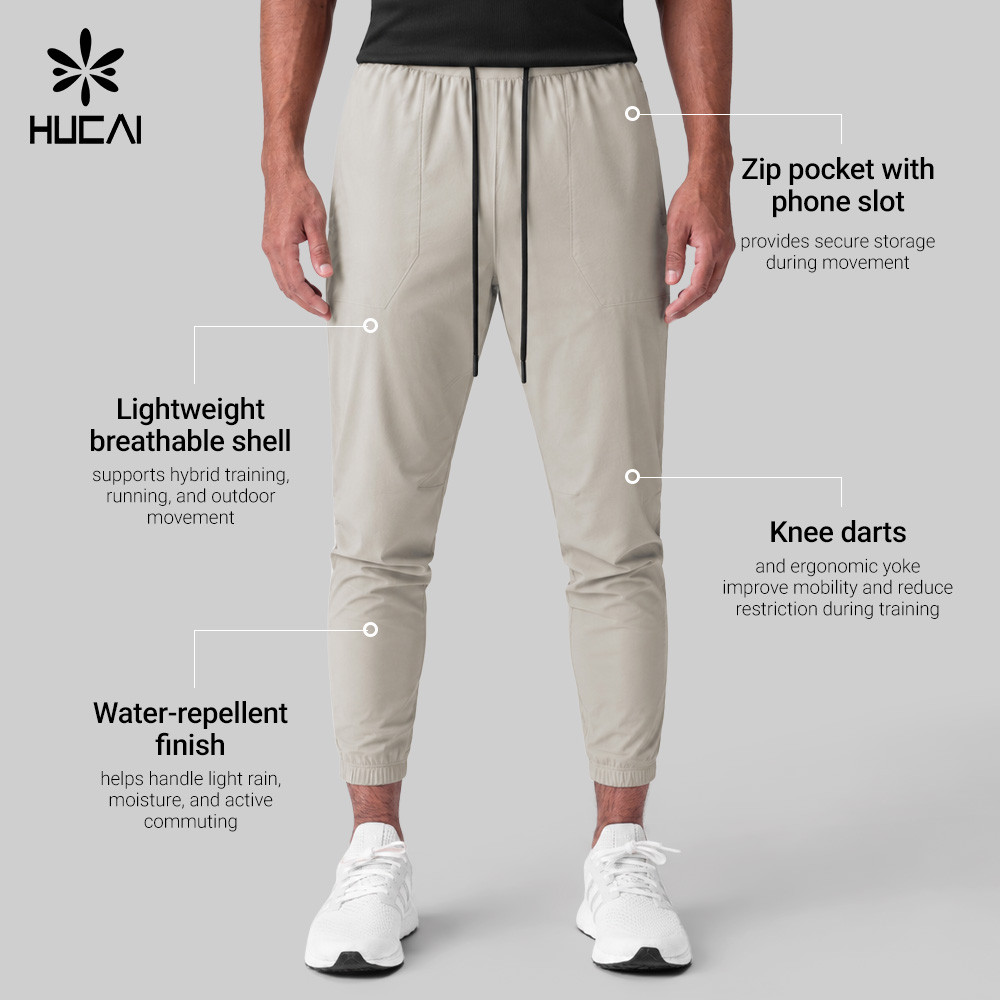
Woven running trousers usually rely on either mechanical stretch or elastane. Mechanical stretch recovers less predictably after repeated extension; elastane gives cleaner recovery but adds cost and needs controlled heat setting. A four-way woven at 130 to 190 gsm with a durable water-repellent finish is the common compromise for tempo and commuting use. The finish itself is a development decision, not an afterthought: it affects hand feel, noise, breathability and how the garment behaves after the tenth wash.

Tests worth writing into the tech pack
Three test logics do most of the work in this category. ISO 6330 dimensional stability washing procedures show how much a synthetic blend with high elastane content moves after repeated domestic cycles, which is the difference between a sample that fits at approval and a bulk garment that does not. AATCC 135 appearance-after-washing evaluation catches pilling, fuzzing and seam distortion that a visual sample review misses. ASTM D2594 stretch and recovery testing quantifies whether the fabric returns to its original length, which is the property runners feel as bagging at the knee after an hour.
Where a trouser has a reinforced seat or knee panel, abrasion resistance is worth specifying as well, using a standard Martindale abrasion method. These are test protocols rather than guarantees: they tell you how a fabric family behaves, not how a specific production lot will perform. The point of naming them in the tech pack is to give the mill and the factory a shared reference instead of an argument after shipment.
This is also where HUCAI activewear's fabric library earns its place in a development timeline: base cloths are compared against the intended role before sampling, so a brand does not spend a sample round on a woven that cannot pass the recovery test its own wear test will demand.
Pattern engineering: where a running trouser is won or lost
Most sample revisions in running legwear come from the block, not the fabric. A jogger block is drafted for standing and walking: the seat is shallow, the knee line is straight, and the leg opening is sized for a sneaker rather than for a moving ankle. When that block is cut in a light woven, restriction appears immediately.
Seat depth and rise
A running stride lengthens the hip extension behind the body. If the back rise is drafted to streetwear depth, the waistband rides down and the crotch seam pulls forward, which runners report as a constant readjustment mid-run. Pattern makers in technical apparel generally add back rise and seat depth for running blocks compared with a gym jogger, then verify it in a walking and jogging fit rather than a standing measurement check alone.
Knee articulation and gusset
An articulated knee - either a shaped leg line with a slight functional bend, or knee darts combined with an ergonomic yoke - removes the pull that appears just above the kneecap in a straight-leg draft. A crotch gusset adds range without adding outer-leg volume. The cost is pattern complexity and extra cut pieces; the benefit is that a woven trouser stops behaving like a restrictive shell.

The same logic applies to the thigh sweep. A tapered leg is a commercial requirement in this category, but taper has to be taken from the knee down, not from the seat. Removing width at the upper thigh is the fastest way to create a garment that photographs well and fails the first long run.
Hem, cuff and shoe interface
The hem is where most running trousers look correct and behave badly. An elastic cuff sized for streetwear grips the ankle and rides up during stride; a cuff that is too loose flaps and catches the heel counter. Development teams usually test two or three hem options on the same block: a clean hem with a short side split, a narrow elastic cuff, and an ankle zip. The decision depends on the shoe silhouette the brand expects its customer to wear, which is a detail worth asking about rather than assuming.
Grading matters as much as the base size. Waist and hip increments, inseam consistency across sizes, and the measurement tolerances agreed in the tech pack determine whether a size medium sample represents the range. A trouser that fits perfectly in medium and pulls in large is usually a grading problem, not a fabric problem.
Storage, waistband and cuff details
Storage is the feature buyers ask about first and the one that most often disappoints in wear. A running trouser needs a pocket that holds a phone against the body without oscillation, which is a construction question rather than a size question.

A side zip pocket works when the pocket bag is anchored to the side seam and the zip sits at an angle that follows the hand. A horizontal zip placed on the thigh sweep will gap open when the leg lifts. Development teams at HUCAI activewear size the pocket bag against the actual phone dimension the target market uses, place the zip opening so it can be operated with one hand, and specify a mesh or perforated pocket bag so water does not pool.
Waistbands fail in two ways: rolling and pressure. A narrow elastic band with a heavy drawcord rolls under a moving load, and a wide band with high tension leaves a mark after an hour. A waistband in the 4 to 5 cm range with an internal drawcord, flat cord ends and a soft edge usually balances both. Where a brand wants a clean external look, a bonded or laser-cut waistband is possible, but it removes the adjustability that heavier runners tend to want.
Small trims deserve the same scrutiny. Zip pullers that swing create noise and catch a jacket hem; overlong cord ends whip against the thigh; a key loop at the side seam sits on the hip bone. All are cheap to fix at development stage and expensive to fix after bulk.
Seams, chafe control and sample validation
Chafe is a seam and placement problem before it is a fabric problem. On knits, a four-needle six-thread flatlock seam lies flat and stretches with the fabric; on wovens, a narrow seam with a bonded or taped finish reduces bulk where the inner thigh and the crotch gusset meet. The seam allowance then has to be finished so no raw edge can lift after washing.
Thread choice is part of the specification. A high-tenacity polyester core thread matched to the fabric's stretch keeps a seam from cracking when the garment is pulled on. Where a brand specifies a contrast stitch for visual effect, the same seam still has to pass the stretch and recovery test, which is why decorative stitching on a high-stretch panel is usually kept away from the seat and knee.
Validation is where a running trouser program is either confirmed or corrected. A workable sequence is: fit session on a live model in motion, a short wear test with two or three runners across different sessions, a wash cycle set that includes at least five domestic washes, and a measurement check against the tech pack after washing. Only then does the style move to pre-production review and bulk planning.
At that stage, HUCAI activewear runs quality checkpoints against AQL 2.5 inspection logic and tracks fabric, trims, pattern, sample, bulk and QC status through MES and ERP records, so a measurement or trim change agreed after the fit session is visible to the line rather than carried in an email. That visibility does not eliminate defects - it reduces the number of avoidable surprises between approved sample and shipped bulk.
Founder's Insight: Jean Yuan on reusing a jogger block
Jean Yuan, Founder of HUCAI activewear, has spent more than two decades on pattern tables and bulk production floors, and has a standing objection to one shortcut that looks economical on paper.
"The cheapest way to build a running trouser is to take the jogger block you already have and change the fabric. In the sample room it looks free, because the pattern already exists and the fit looks close on a standing model. The cost appears later, and it appears in two places: the knee and the seat. A woven shell has less give than the fleece the block was drafted for, so the same leg line that felt relaxed in terry now pulls at the kneecap and drags at the back rise during stride. By the time a brand feels that in a wear test, it has usually approved the fabric, the trims and the print placement, and the correction becomes a block rebuild in the middle of a sample round."
"There is a second trade-off I raise early with brands chasing a light shell. A durable water-repellent finish and a low fabric weight both reduce stretch and hand feel, so if you take weight out of the shell without adding pattern articulation, you have built a garment that resists rain and fights the leg. On our own tables, the order that works is role first, then block, then fabric weight, then finish. Reversing that order is where most of the avoidable sample rounds come from."
Decision check before you approve a sample
The checklist below is the one used when buyers review a running trouser program with HUCAI activewear. Each line refers to a decision that is cheaper to change before sampling than after.
| Check | What to confirm | Why it matters |
|---|---|---|
| Product role | Jogger, woven running trouser or layer, stated in the tech pack | Prevents one style being asked to cover warm-up and tempo use |
| Fabric and test logic | Base weight, elastane content, finish, and the wash and recovery tests requested | Gives the mill and factory a shared reference before bulk |
| Block and articulation | Back rise, seat depth, knee articulation, gusset, grading increments | Removes the pull that appears in stride rather than standing |
| Hem strategy | Cuff type tested against the intended shoe silhouette | Prevents riding up or heel catch |
| Storage | Pocket bag size, zip position and angle, drainage | Stops phone oscillation and water pooling |
| Seam plan | Seam type on knit and woven panels, allowance finishing, thread spec | Reduces chafe at inner thigh and gusset |
| Validation sequence | Fit session, wear test, wash set, post-wash measurement | Confirms the approved sample represents bulk |
FAQ
What is the difference between a running trouser and a jogger?
A jogger is built for warmth and street use, usually from a brushed knit with an elastic cuff and open pockets. A running trouser is built for movement at pace: a lighter shell or a closer knit, an articulated knee, a seat depth that allows stride, secure storage and a controlled hem. The two can share a waistband treatment, but they should not share a block.
Which fabric should a brand choose first, a knit or a woven?
Choose by role. A knit jogger suits warm-up, recovery and cold easy runs. A light woven with stretch and a water-repellent finish suits tempo, commuting and wet weather. If the range needs one style only, a woven trouser with knit inserts at the waistband and gusset covers more use cases, at the cost of a more complex seam plan.
What is the MOQ for custom men's running trousers?
MOQ from 200 pcs per style is the published starting point for custom men's activewear, and the real number depends on fabric, colour, size range, trims, logo method and order structure. A fabric that has to be developed in a new colour usually moves the number more than the garment complexity does.
How long does a sample round usually take for running legwear?
Sample timing depends on fabric availability, pattern work, logo method, fit adjustment and the number of revision rounds. A block that already exists and a fabric that is in stock move faster than a new block with a developed shell. It is more useful to agree the revision limit up front than to ask for a single fixed date.
Do we need a tech pack before starting development?
Not in every case. Established brands usually arrive with a tech pack and confirmed measurements, which suits OEM. Growing brands often arrive with reference images, a target price and a use case, which suits ODM support where the block, fabric options and construction are proposed together. Startup brands benefit most from defining role, fabric family and quantity before any pattern work starts.
Why do running trousers feel restrictive at the knee even when the fabric stretches?
Because stretch and articulation solve different problems. Stretch lets a fabric extend; articulation changes where the extension is needed. A straight knee line drafted for walking will pull above the kneecap regardless of elastane content. Knee darts, a functional bend in the leg line, or a gusset address the geometry rather than the elasticity.
How should a brand validate a running trouser before bulk production?
Run a fit session on a live model in motion, then a short wear test with two or three runners, then a wash set of at least five domestic cycles, then a post-wash measurement check against the tech pack. Review the results together before pre-production. Approving a sample from a standing fitting alone is the most common reason bulk complaints appear later.
Final Takeaway
A more technical alternative to standard joggers is not a fabric upgrade. It is a role decision followed by a block decision, and only then a fabric decision. Brands that separate warm-up legwear from running legwear, articulate the knee and seat before choosing a shell, and validate with a wash set rather than a single fitting end up with fewer sample rounds and a garment that survives its own reviews.
The commercial value sits in that clarity: a running trouser that behaves like running equipment can carry a higher price than a jogger, and it gives a range a technical story that shorts and T-shirts alone cannot tell.
Next Steps
Ready to develop the style? Share your tech pack, reference images or target product direction and the team will review the block and fabric options before quoting. Send your running trouser brief.
Need development support rather than production only? Review the OEM and ODM routes for fabric, fit, sample and range planning: OEM men's sportswear development and ODM men's sportswear development.
Still comparing options? Start with the fabric decision and the existing legwear range: fabric choices for men's sportswear, jogger and sweatpant range, compression and leggings range, and the manufacturing FAQ.
HUCAI activewear supports men's running and training legwear through OEM and ODM development, pattern and sample work, fabric and trim sourcing, AQL 2.5 quality inspection and production follow-up, with status tracked from sample approval to shipment. Timelines and costs are quoted against confirmed specifications rather than published as fixed figures.